前言节选:
PREFACE
As I mention in the Preface to the previous book (Dorman, M2004), after graduation in December 1950 Moscow Lomonosov State University (Nuclear and Elementary Particle Physics Division, the Team of Theoretical Physics), my supervisor Professor Dmitry Ivanovich Blokhintsev planned for me, as a winner of a Red Diploma, to continue my education as an aspirant (a graduate student) to prepare for Ph.D. in his very secret Object in the framework of what was in those time called the Atomic Problem. To my regret the KGB withheld permission, and I, together with other Jewish students who had graduated Nuclear Divisions of Moscow and Leningrad Universities and Institutes, were faced with a real prospect of being without any work. It was our good fortune that at that time there was being brought into being the new Cosmic Ray Project (what at that time was also very secret, but not as secret as the Atomic Problem), and after some time we were directed to work on this Project. It was organized and headed by Prof. Sergey Nikolaevich Vernov (President of All-Union Section of Cosmic Rays) and Prof. Nikolay Vasiljevich Pushkov (Director of IZMIRAN); Prof. Evgeny Lvovich Feinberg headed the theoretical part of the Project. Within the framework of this Project there was organized in former Soviet Union in 19511952 a wide network of CR stations equipped with a Compton type of large ASC-1 and ASC-2 ionization chambers developed in USSR (see Sections 1.2.7 and 4.2 in Dorman, M2004).
At that time many experimental results on CR time variations were obtained, but they were very considerably affected by meteorological effects and by mesonnuclear cascade in the atmosphere. Therefore it was not possible to make reasonable transformation from observed CR time variations in the atmosphere and underground to the variations expected in space. To solve this problem, it became necessary to develop a full theory of cosmic ray meteorological effects and a special method of coupling functions between primary and secondary CR variations (this work was finished at the end of 1951 and was described in the IZMIRAN’s Instructions on CR Data Processing, see References to Chapter 1 of Dorman, M2004: Dorman, 1951a,b). Only from 1954 it becomes possible for our work on CR variations to appear in the open scientific literature, and from 1955 – to take part (by presentation of papers) in International Cosmic Ray Conferences. Mainly our results of that time were described in my
first book (Dorman, M1957, which was translated very soon into English in the USA, thanks to the help of Professor John Simpson, at those time President of International CR Commission). Soon after this, in 1958, under the auspices of the International CR Commission the Committee of CR Meteorological Effects was organized, and I became its Chairman. Under the auspices of this Committee a special Instruction for CR Data Processing was developed which took into account corrections on meteorological effects.
In 1957 I was invited to work on special problems in Magnetic Laboratory of the Academy of Sciences of USSR as a Head of Department of Magnetic Hydrodynamics. In few years this Laboratory was transfered into the I.V. Kurchatov Institute of Atomic Energy, and I continued to work in this Institute up to 1965. In parallel I also worked at Moscow State University as Professor in the CR and Space Research Team. I also gave lectures in Irkutsk, Alma-Ata, Nalchik, Tbilisi, Erevan, Samarkand, and others places. Over about 40 years of teaching under my supervision more than hundred graduate students and scientists in USSR and some other countries gained their Ph.D. and several tenths became Doctors of Science. As my hobby I continued to work in CR research, and as Vice-President of All-Union Section of Cosmic Rays and Radiation Belts, took an active part in preparing the Soviet net of CR stations to the IGY (International Geophysical Year, 1957-1958): we equipped all soviet stations in USSR and in Antarctica with standard cubic and semi-cubic muon telescopes and with neutron monitors of IGY (or Simpson’s) type. In connection with preparing for the IQSY (the International Quiet Sun Year, 1964-1965), the soviet net of CR stations was extended about two fold and they were equipped with neutron super-monitors of IQSY type (with an effective surface about 10 times bigger than the previous monitor of IGY type).
In 1965 I returned to IZMIRAN, and founded the Cosmic Ray Department (thanks to help of Professor N.V. Pushkov and Academicians M.D. Millionshchikov, L.A. Artsymovich, and V.I. Veksler). For the next 30 years, I was a Head of this Department, which became the center in the Soviet Union of scientific CR research in geophysical and astrophysical aspects. Our Department supported the work of all Soviet CR stations in the USSR and undertook the entire work of Soviet CR stations in Antarctica. We organized many CR expeditions inside USSR and in the Arctic Ocean, as well as in Pacific, Atlantic, Indian, and Southern Oceans on the ships “Academician Kurchatov”, “Kislovodsk” and others (expeditions were equipped with a neutron super-monitor of IQSY type, with a multi-directional muon telescope, with radio-balloon CR measurements in the troposphere and stratosphere). Much very important data were obtained about coupling functions, integral multiplicities, and on the planetary distribution of cutoff rigidities.
From 1955 I took part in all International Cosmic Ray Conferences by presenting of original papers, as well as Invited Papers (in 1959 and 1965), Rapporteur Papers (in 1969 and 1987), Highlight Paper (in 1999), but I was able to go abroad only in 1966-1969 (thanks to N.V. Pushkov and M.D. Millionshchikov) and then from 1988, after “perestroika”. The
first country I traveled to was Bulgaria (the International School on Space Physics), then Yugoslavia (the International Symposium on Solar-Terrestrial Relations) in 1966. In 1967-1968 I headed the CR expedition to South America on the ship “Kislovodsk”, went to Czechoslovakia in 1968, and to the International CR Conference in Budapest in 1969. Then up to 1988 I had no permission to go abroad. After ‘perestroika’, thanks to invitations: from K. Nagashima I went to Japan, from C.J. Cesarsky to France, from A.W. Wolfendale and J.J. Quenby to England, from K. Otaola and J.F. Valdes-Galicia to Mexico, from D. Venkatesan to Canada, from J.A. Simpson and H. Ahluwalia to USA, from W.I. Axford and H.J. Völk to Germany, from A. Bishara to Egypt, from L.O’C. Drury to Ireland, from N. Iucci, G. Villoresi, and M. Parisi to Italy, from P.J. Tanskanen to Finland, from M. Duldig to Australia.
In October of 1989 in Paris I met for the
first time with my eldest brother Abraham Argov. In 1925 with our great grand parents Globman (from the mother side) he went from Ukraine to Palestine, were in those time been Akiva, Pinhas, and Shlomo Globman (Govrin after 1948), three youngest brothers of my mother (they came to Palestine at the beginning of 1920-th). In Palestine Abraham took active part in the foundation and governing of the prominent kibbutz Beit-Hashita in the Yizreel Valley. As an officer, he took part in the War of Independence in 1948 (when his family name was changed to Hebrew, Argov). Abraham, together with my cousin Michal Govrin-Brezis, organized my
first visit to Israel in 1990 and arranged my meeting with Prof. Yuval Ne'eman. Ne'eman, who soon became the Minister of Science, played an important role in the formation of the Israel Cosmic Ray and Space Weather Centre and the Emilio Segre' Observatory. In 1991 I was invited by Prof. Yuval Ne'eman, as Minister of Science, to visit Israel with family for one year (the Institute of Advance Study at Tel Aviv University) to give lectures and organize a Cosmic Ray Research Center.
Step by
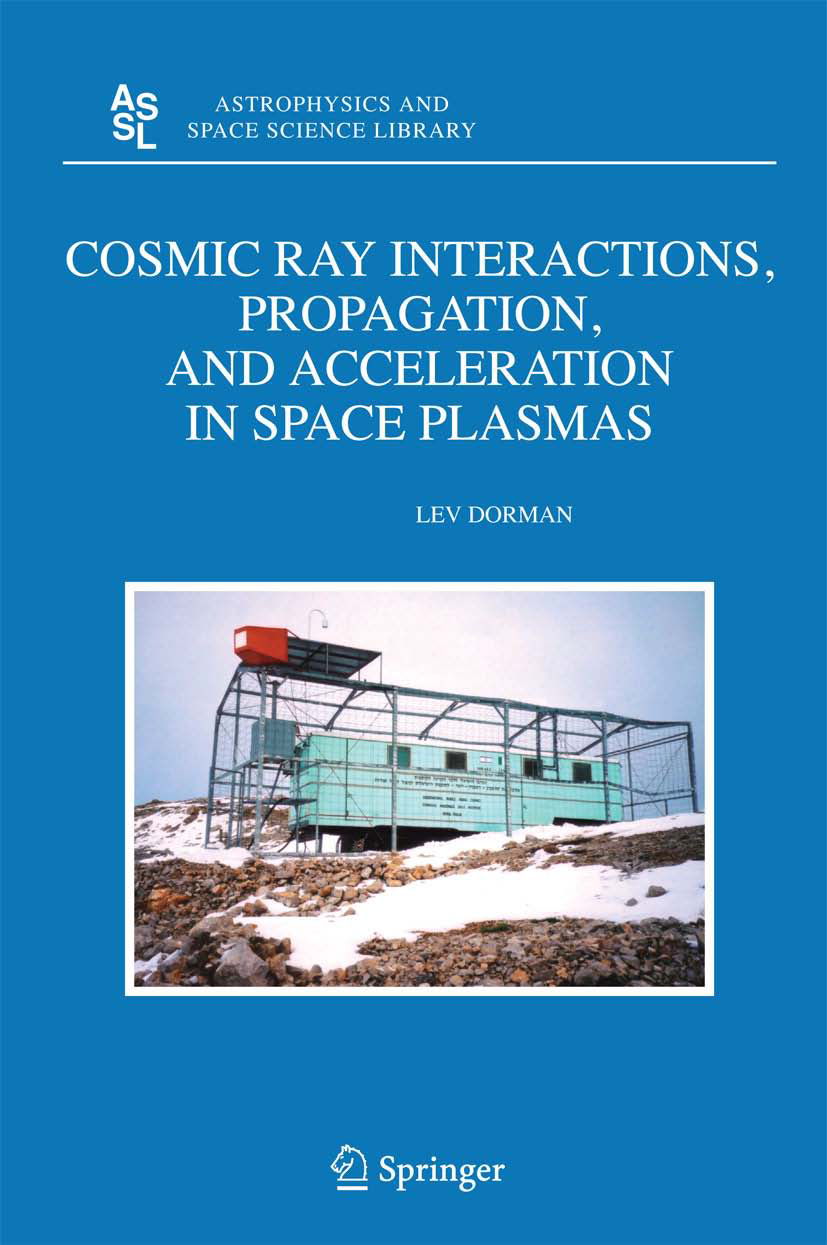
step, thanks to great help of Prof. Yuval Ne’eman, Dr. Abraham Sternlieb, Mr. Aby Har-Even, Major of Qazrin Sami Bar Lev, and of three Italian colleagues, Prof. Nunzio Iucci, Dr. Giorgio Villoresi, and Prof. Mario Parisi, there was founded the Israel Cosmic Ray & Space Weather Center with the Israeli-Italian Emilio Segre’ Observatory on Mt. Hermon (now 2055 m above sea level, cut-off rigidity 10.8 GV; see description in Dorman, M2004, Section 4.8), and I became a Head of this Center and Observatory (up to present I continue also to work as a volunteer in IZMIRAN as Chief Scientist of the Cosmic Ray Department, which has been headed since 1995 by my former student, Dr. Victor G. Yanke).
About four years ago I was invited by Dr. Harry Bloom to prepare monographs on geophysical and space aspects of CR research and possible applications of them. The monograph Cosmic Rays in the Earth's Atmosphere and Underground was published in 2004. Now is ready the monograph Cosmic Ray Interactions, Propagation and Acceleration in Space Plasmas, and the next Cosmic Rays in the Magnetospheres of the Earth and other Planets will be ready after about one year.
With the problems of CR interactions, propagation and acceleration (or deceleration) in space plasmas I meet at the
first time at the beginning of 1950-th when considered the nature of solar and galactic CR variations in the interplanetary space (great solar flare events, 11-year CR variations connected with solar activity cycle, Forbush decreases of CR intensity caused by geomagnetic storms, CR solar diurnal and semi-diurnal variations caused by CR anisotropy and the Earth's rotation, 27-day variations caused by the sun rotation, and so on). These problems became especially actually when we start to understand the nature of giant solar CR event at February 23, 1956: how particles were accelerated for very short time up to energies more than 10 GeV in conditions of solar chromosphere and corona; how these energetic particles propagate in the interplanetary space; why at the beginning of event was observed a big anisotropy, but after 20-30 minutes the distribution of solar CR became about isotropic? Many scientists tried to give answers on these questions.
The next great CR event was magnetic storm at 29 August 1957, when we at the
first time observed CR particle acceleration by the interplanetary shock wave, so called pre-increase effect (this shock wave caused also geomagnetic storm and Forbush decrease in CR intensity). Investigation of the pre-increase effect stimulated developing of the drift mechanism of charged particle acceleration at single interaction with the shock wave. After about 20 years this mechanism was extended by taken into account scattering and multi-interaction of accelerated particles with shock wave (so called diffusion or regular mechanism of particle acceleration by shock waves).
The detailed Contents gave information on the problems considered and discussed in the monograph. The Chapter 1 shortly describes main properties of space plasmas and main properties of primary CR, considered in details different types of CR interactions: with space plasmas matter with generation many secondary particles, ionization and other energy looses, interactions with photons and electromagnetic radiation, interactions with frozen in space plasmas stationary and moving magnetic fields of different configurations (including magnetic traps). In this Chapter we consider also the interaction of extremely high energy CR with relict 2.7° K and extremely high energy gamma-rays with magnetic fields of the Sun and planets. We consider here also gamma-ray generation in solar and stellar winds by interactions of galactic and flare energetic particle with space
plasma matter.
In Chapter 2 we consider the problem of CR propagation in space plasmas describing by kinetic equation and different types of diffusion approximation. Especially are considered the kinetics of CR in a large scale magnetic fields, diffusion in the momentum space and in pitch-angle space, anisotropic diffusion. In details are considered balance of CR energy in multiple scattering in expanding magnetic fields, anomaly CR diffusion and mean free path in the
Alfven wave heated space
plasma, bulk speeds of CR resonant with parallel
plasma waves, the CR cross-field diffusion in the presence of highly perturbed magnetic fields, dispersion relations for CR particle diffusive propagation and path integral solution to the stochastic differential equation of the Markov process for CR
transport, the compound diffusion, the influence of magnetic clouds on the CR propagation, nondiffusive CR particle pulse
transport, and so on.
Chapter 3 devoted to CR non-linear effects in space
plasma caused by CR pressure CR kinetic stream instabilities. These effects are important in our Galaxy and other galaxies (galactic wind driven by CR and influence on CR propagation, chemical composition and energy spectrum formation), in the Heliosphere (dynamics effects of galactic CR pressure on solar wind propagation, on the formation of terminal shock wave and the boundary of the Heliosphere, Alfven turbulence generation by kinetic stream instability of non isotropic CR fluxes and its influence on CR propagation and modulation), in CR and gamma-ray sources (influence of CR pressure and CR stream instability of escaping energetic particles on acceleration efficiency and formation of energy spectrum and chemical composition of escaping particles, influence of nonlinear effects on gamma-ray emissivity distribution), in the processes of CR acceleration by shock waves and in other acceleration processes (inverse influence of pressure and stream instability of accelerated particles on the structure and propagation of shock waves, on processes of reconnection, on formation of accelerated particles energy spectrum and chemical composition).
In Chapter 4 we consider different processes of CR acceleration in space
plasma. In the
first, we show that the particles acceleration in space
plasma is an universal phenomenon in the Universe, realized in about all astrophysical objects. In details are considered the Fermi statistical mechanism of particle acceleration and its developing, formation of particle energy spectrum during statistical acceleration by taking into account the dependence of main parameters of mechanism (
transport path, velocities of scatterers, escaping parameters) with increasing of particle energy, determining of injection energy and the portion of the accelerated particles in the statistical mechanism. Especially are considered statistical acceleration in the turbulent
plasma and by electromagnetic radiation, by the Alfven mechanism of magnetic pumping, and so on. Critically are considered possibility of induction acceleration mechanisms. We consider mechanisms of particle acceleration by shock waves and other moving magneto-hydrodynamic discontinuities during single interaction, particle acceleration in case of magnetic collapse and compression, the cumulative acceleration mechanism near the zero lines of magnetic field, particle acceleration in shear flows of space
plasma, and additional regular particle acceleration in space
plasma with two types of scatters moving with different velocities. In details we consider also quickly developed in the last 30 years mechanisms of shock-wave diffusion (regular) acceleration without and with accounting non-linear processes, particle acceleration by relativistic shock waves and by the electrostatic shock waves.
At the beginning of monograph, there is Frequently used Abbreviations and Notations. At the end of book, in the Conclusion and Problems we summarize main results and consider some unsolved key problems, important for development of the considered branch of CR Astrophysics and Geophysics. In the References there are separately references for Monographs and Books as well as for each Chapter. For the convenience of the reader, at the end of book we also put Object Index and Author Index.
We shall be grateful for any comments, suggestions, preprints and reprints which can be useful in our future research, and can make the next Edition of the book better and clearer; they may be sent directly to me by e-mail (lid@physics.technion.ac.il), by fax [+972] 4 696 4952, and by surface or air-mail to the address: Prof. Lev I. Dorman, Head of ICR&SWC and ESO, P.O. Box 2217, Qazrin 12900, ISRAEL.
Lev I. Dorman
27 June 2005 - 27 February 2006.
Qazrin, Moscow, Princeton

评论 (0)