
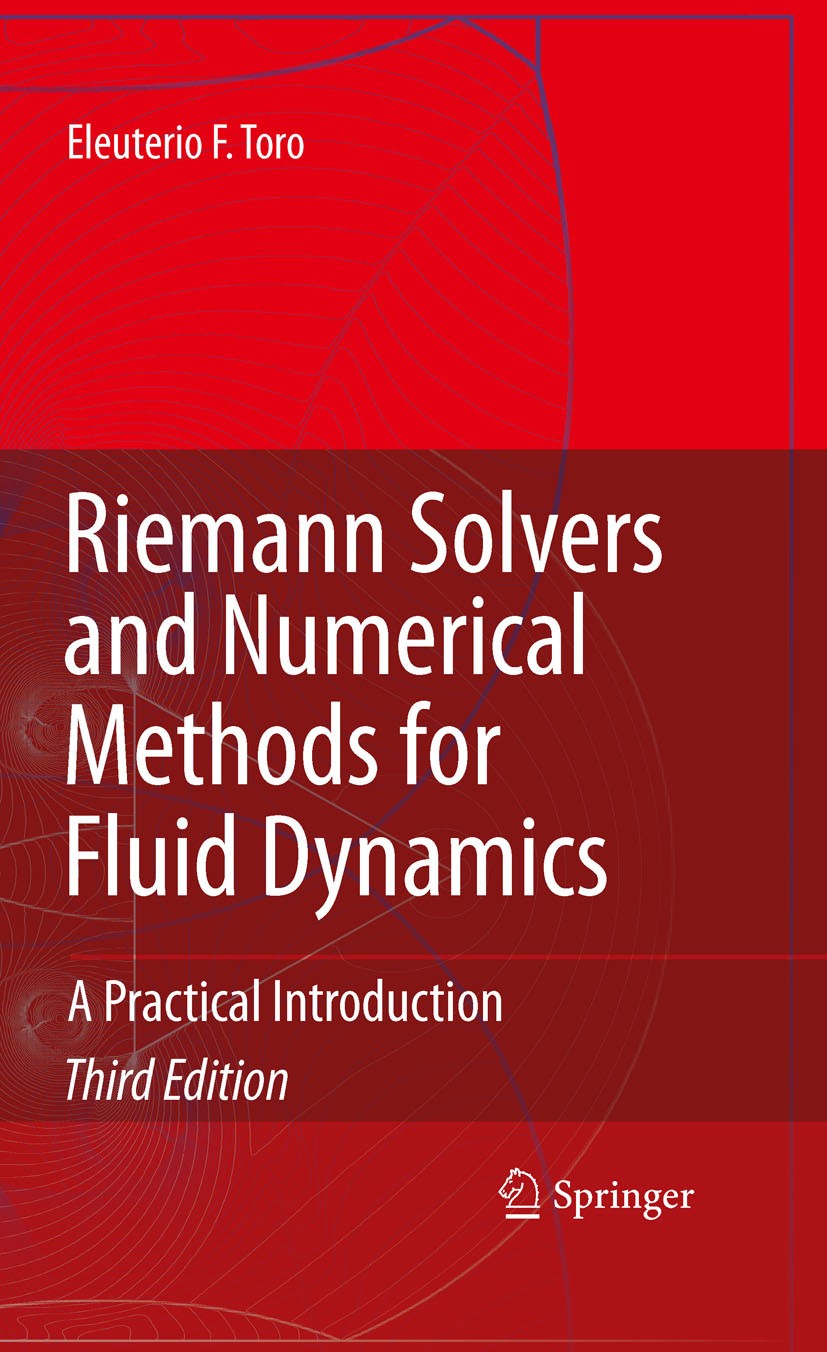
Riemann_Solvers_and_Numerical_Methods_for_Fluid_Dynamics-Springer
A Practical Introduction
- 作者:
- Eleuterio F. Toro
- 译者:
- 暂无资料
- 出版社:
- Springer
- 出品方:
- 暂无资料
- 出版日期:
- 2009-04-27
- 2009
- ISBN:
- 978-3-540-25202-3
- 3-540-25202-9
- 页数:
- XXIV, 724页
- 装帧:
- 精装(Hardcover)
- 定价:
- 精装版:页面划线参考价 EUR 299.99,折扣售价 EUR 209.99,均不含中国地区VAT;电子书 EUR 245.03,含页面标示中国地区VAT(2026-11-05读取)。
- 丛书:
- 暂无资料
内容简介
- 创作背景:
- 本书内容来自作者多年数值方法研究、实际应用和研究生教学,起点是英国 Cranfield 航空学院计算流体力学硕士课程模块,并吸收多国短期课程和讲座材料。
- 核心观点:
- Godunov 方法以黎曼问题的解构造界面通量;精确与近似求解器提供不同实现途径;高阶和 TVD 方法提高分辨率并控制振荡;广义黎曼问题为时空任意高阶单步格式提供构造基础。
- 研究问题:
- 如何精确或近似求解双曲守恒律的黎曼问题?如何构造激波捕捉、高阶及 TVD 格式?如何处理源项、多维几何与结构或非结构网格?
- 主要人物:
- 暂无资料
- 涉及地点:
- 英国 Cranfield、Manchester;意大利 Trento;德国 Freiburg、Aachen;日本 Sendai;智利 Valparaiso(序言记载的课程、讲座及写作关联地点)
- 涉及事件:
- 1917年 L. F. Richardson 尝试以手工数值求解偏微分方程进行天气预报(作者在初版序言中作为计算流体力学历史背景介绍)。
- 相关术语:
- 黎曼问题;双曲守恒律;Euler 方程;Godunov 方法;HLL/HLLC;Roe 求解器;Osher 求解器;TVD;MUSCL-Hancock;FORCE;ADER
- 争议与批评:
- 暂无资料
- 简介与摘录译文:
- 暂无资料
- 原始简介/摘要:
- 暂无资料
创作者与相关人物
- 作者简介:
- Eleuterio F. Toro:本书作者;第三版序言署名时任职于意大利特伦托大学(University of Trento)。
- 作者:
- Eleuterio F. Toro
- 编者/主编:
- 暂无资料
- 译者:
- 暂无资料
- 插画师:
- 暂无资料
- 摄影师:
- 暂无资料
- 序言作者:
- Eleuterio Toro
- 后记作者:
- 暂无资料
- 校注者:
- 暂无资料
- 机构作者:
- 暂无资料
- 责任编辑:
- 暂无资料
- 研究者与评论者:
- 暂无资料
目录
- 章节目录:
- Preface to the First Edition VII Preface to the Third Edition XI 1 The Equations of Fluid Dynamics 1 1.1 The Euler Equations 2 1.1.1 Conservation–Law Form 3 1.1.2 Other Compact Forms 4 1.2 Thermodynamic Considerations 5 1.2.1 Units of Measure 5 1.2.2 Equations of State (EOS) 6 1.2.3 Other Variables and Relations 7 1.2.4 Ideal Gases 11 1.2.5 Covolume and van der Waal Gases 13 1.3 Viscous Stresses 15 1.4 Heat Conduction 17 1.5 Integral Form of the Equations 18 1.5.1 Time Derivatives 19 1.5.2 Conservation of Mass 20 1.5.3 Conservation of Momentum 21 1.5.4 Conservation of Energy 23 1.6 Submodels 25 1.6.1 Summary of the Equations 25 1.6.2 Flow with Area Variation 27 1.6.3 Axi–Symmetric Flows 28 1.6.4 Cylindrical and Spherical Symmetry 29 1.6.5 Plain One–Dimensional Flow 29 1.6.6 Steady Compressible Flow 31 1.6.7 Viscous Compressible Flow 33 1.6.8 Free–Surface Gravity Flow 33 1.6.9 The Shallow Water Equations 35 1.6.10 Incompressible Viscous Flow ..... 38 1.6.11 The Artificial Compressibility Equations ..... 39 2 Notions on Hyperbolic Partial Differential Equations ..... 41 2.1 Quasi–Linear Equations: Basic Concepts ..... 42 2.2 The Linear Advection Equation ..... 47 2.2.1 Characteristics and the General Solution ..... 47 2.2.2 The Riemann Problem ..... 49 2.3 Linear Hyperbolic Systems ..... 50 2.3.1 Diagonalisation and Characteristic Variables ..... 51 2.3.2 The General Initial-Value Problem ..... 52 2.3.3 The Riemann Problem ..... 55 2.3.4 The Riemann Problem for Linearised Gas Dynamics .. 58 2.3.5 Some Useful Definitions ..... 60 2.4 Conservation Laws ..... 61 2.4.1 Integral Forms of Conservation Laws ..... 62 2.4.2 Non–Linearities and Shock Formation ..... 66 2.4.3 Characteristic Fields ..... 77 2.4.4 Elementary-Wave Solutions of the Riemann Problem .. 83 3 Some Properties of the Euler Equations ..... 87 3.1 The One-Dimensional Euler Equations ..... 87 3.1.1 Conservative Formulation ..... 87 3.1.2 Non-Conservative Formulations ..... 91 3.1.3 Elementary Wave Solutions of the Riemann Problem .. 94 3.2 Multi-Dimensional Euler Equations ..... 103 3.2.1 Two-Dimensional Equations in Conservative Form .... 104 3.2.2 Three-Dimensional Equations in Conservative Form .... 108 3.2.3 Three-Dimensional Primitive Variable Formulation .... 109 3.2.4 The Split Three-Dimensional Riemann Problem ..... 111 3.3 Conservative Versus Non-Conservative Formulations ..... 112 4 The Riemann Problem for the Euler Equations ..... 115 4.1 Solution Strategy ..... 116 4.2 Equations for Pressure and Particle Velocity ..... 119 4.2.1 Function $f_{\mathrm{L}}$ for a Left Shock ..... 120 4.2.2 Function $f_{\mathrm{L}}$ for Left Rarefaction ..... 122 4.2.3 Function $f_{\mathrm{R}}$ for a Right Shock ..... 123 4.2.4 Function $f_{\mathrm{R}}$ for a Right Rarefaction ..... 124 4.3 Numerical Solution for Pressure ..... 125 4.3.1 Behaviour of the Pressure Function ..... 125 4.3.2 Iterative Scheme for Finding the Pressure ..... 127 4.3.3 Numerical Tests ..... 129 4.4 The Complete Solution ..... 132 4.5 Sampling the Solution ..... 136 4.5.1 Left Side of Contact: $S = x / t \leq u_*$ 137 4.5.2 Right Side of Contact: $S = x / t \geq u_*$ 137 4.6 The Riemann Problem in the Presence of Vacuum 139 4.6.1 Case 1: Vacuum Right State 140 4.6.2 Case 2: Vacuum Left State 142 4.6.3 Case 3: Generation of Vacuum 142 4.7 The Riemann Problem for Covolume Gases 143 4.7.1 Solution for Pressure and Particle Velocity 144 4.7.2 Numerical Solution for Pressure 147 4.7.3 The Complete Solution 147 4.7.4 Solution Inside Rarefactions 148 4.8 The Split Multi-Dimensional Case 149 4.9 FORTRAN Program for Exact Riemann Solver 151 5 Notions on Numerical Methods 163 5.1 Discretisation: Introductory Concepts 163 5.1.1 Approximation to Derivatives 164 5.1.2 Finite Difference Approximation to a PDE 165 5.2 Selected Difference Schemes 168 5.2.1 The First Order Upwind Scheme 168 5.2.2 Other Well-Known Schemes 172 5.3 Conservative Methods 174 5.3.1 Basic Definitions 175 5.3.2 Godunov's First-Order Upwind Method 177 5.3.3 Godunov's Method for Burgers's Equation 181 5.3.4 Conservative Form of Difference Schemes 184 5.4 Upwind Schemes for Linear Systems 187 5.4.1 The CIR Scheme 188 5.4.2 Godunov's Method 190 5.5 Sample Numerical Results 194 5.5.1 Linear Advection 194 5.5.2 The Inviscid Burgers Equation 196 5.6 FORTRAN Program for Godunov's Method 196 6 The Method of Godunov for Non-linear Systems 213 6.1 Bases of Godunov's Method 213 6.2 The Godunov Scheme 216 6.3 Godunov's Method for the Euler Equations 218 6.3.1 Evaluation of the Intercell Fluxes 219 6.3.2 Time Step Size 221 6.3.3 Boundary Conditions 222 6.4 Numerical Results and Discussion 225 6.4.1 Numerical Results for Godunov's Method 226 6.4.2 Numerical Results from Other Methods 228 7 Random Choice and Related Methods 237 7.1 Introduction 237 7.2 RCM on a Non-Staggered Grid 238 7.2.1 The Scheme for Non-Linear Systems 239 7.2.2 Boundary Conditions and the Time Step Size 243 7.3 A Random Choice Scheme of the Lax-Friedrichs Type 244 7.3.1 Review of the Lax-Friedrichs Scheme 244 7.3.2 The Scheme 245 7.4 The RCM on a Staggered Grid 247 7.4.1 The Scheme for Non-Linear Systems 247 7.4.2 A Deterministic First-Order Centred Scheme (FORCE) 247 7.4.3 Analysis of the FORCE Scheme 249 7.5 Random Numbers 250 7.5.1 Van der Corput Pseudo-Random Numbers 250 7.5.2 Statistical Properties 251 7.5.3 Propagation of a Single Shock 253 7.6 Numerical Results 255 7.7 Concluding Remarks 256 8 Flux Vector Splitting Methods 265 8.1 Introduction 265 8.2 The Flux Vector Splitting Approach 266 8.2.1 Upwind Differencing 266 8.2.2 The FVS Approach 268 8.3 FVS for the Isothermal Equations 270 8.3.1 Split Fluxes 271 8.3.2 FVS Numerical Schemes 272 8.4 FVS Applied to the Euler Equations 273 8.4.1 Recalling the Equations 274 8.4.2 The Steger-Warming Splitting 276 8.4.3 The van Leer Splitting 277 8.4.4 The Liou-Steffen Scheme 278 8.5 Numerical Results 280 8.5.1 Tests 280 8.5.2 Results for Test 1 280 8.5.3 Results for Test 2 281 8.5.4 Results for Test 3 281 8.5.5 Results for Test 4 282 8.5.6 Results for Test 5 282 9 Approximate-State Riemann Solvers 293 9.1 Introduction 293 9.2 The Riemann Problem and the Godunov Flux 294 9.2.1 Tangential Velocity Components 296 9.2.2 Sonic Rarefactions 296 9.3 Primitive Variable Riemann Solvers (PVRS) 297 9.4 Approximations Based on the Exact Solver 301 9.4.1 A Two-Rarefaction Riemann Solver (TRRS) 301 9.4.2 A Two-Shock Riemann Solver (TSRS) 303 9.5 Adaptive Riemann Solvers 304 9.5.1 An Adaptive Iterative Riemann Solver (AIRS) 304 9.5.2 An Adaptive Noniterative Riemann Solver (ANRS) 305 9.6 Numerical Results 306 10 The HLL and HLLC Riemann Solvers 315 10.1 Introduction 315 10.2 The Riemann Problem 317 10.2.1 The Godunov Flux 317 10.2.2 Integral Relations 318 10.3 The HLL Approximate Riemann Solver 320 10.4 The HLLC Approximate Riemann Solver 322 10.4.1 Useful Relations 322 10.4.2 The HLLC Flux for the Euler Equations 324 10.4.3 Multidimensional and Multicomponent Flow 326 10.5 Wave-Speed Estimates 327 10.5.1 Direct Wave Speed Estimates 328 10.5.2 Pressure-Based Wave Speed Estimates 329 10.6 Summary of HLLC Fluxes 331 10.7 Contact Waves and Passive Scalars 333 10.8 Numerical Results 334 10.9 Closing Remarks 336 11 The Riemann Solver of Roe 345 11.1 Bases of the Roe Approach 346 11.1.1 The Exact Riemann Problem and the Godunov Flux 346 11.1.2 Approximate Conservation Laws 347 11.1.3 The Approximate Riemann Problem and the Intercell Flux 349 11.2 The Original Roe Method 351 11.2.1 The Isothermal Equations 352 11.2.2 The Euler Equations 354 11.3 The Roe-Pike Method 358 11.3.1 The Approach 358 11.3.2 The Isothermal Equations 359 11.3.3 The Euler Equations 363 11.4 An Entropy Fix 366 11.4.1 The Entropy Problem 366 11.4.2 The Harten-Hyman Entropy Fix 367 11.4.3 The Speeds $u_{*}, a_{*L}, a_{*R}$ 370 11.5 Numerical Results and Discussion 372 11.5.1 The Tests ....372 11.5.2 The Results ....373 11.6 Extensions....373 12 The Riemann Solver of Osher....377 12.1 Osher's Scheme for a General System ....378 12.1.1 Mathematical Bases ....378 12.1.2 Osher's Numerical Flux ....380 12.1.3 Osher's Flux for the Single-Wave Case ....381 12.1.4 Osher's Flux for the Inviscid Burgers Equation ....383 12.1.5 Osher's Flux for the General Case ....384 12.2 Osher's Flux for the Isothermal Equations ....385 12.2.1 Osher's Flux with P-Ordering ....386 12.2.2 Osher's Flux with O-Ordering ....389 12.3 Osher's Scheme for the Euler Equations ....392 12.3.1 Osher's Flux with P-Ordering ....393 12.3.2 Osher's Flux with O-Ordering ....397 12.3.3 Remarks on Path Orderings ....402 12.3.4 The Split Three-Dimensional Case ....403 12.4 Numerical Results and Discussion ....404 12.5 Extensions....406 13 High-Order and TVD Methods for Scalar Equations ....413 13.1 Introduction ....413 13.2 Basic Properties of Selected Schemes ....415 13.2.1 Selected Schemes ....415 13.2.2 Accuracy ....417 13.2.3 Stability ....418 13.3 WAF-Type High Order Schemes ....420 13.3.1 The Basic WAF Scheme ....420 13.3.2 Generalisations of the WAF Scheme ....423 13.4 MUSCL-Type High-Order Methods ....426 13.4.1 Data Reconstruction ....426 13.4.2 The MUSCL-Hancock Method (MHM) ....429 13.4.3 The Piece-Wise Linear Method (PLM) ....432 13.4.4 The Generalised Riemann Problem (GRP) Method ....434 13.4.5 Slope-Limiter Centred (SLIC) Schemes ....436 13.4.6 Other Approaches ....439 13.4.7 Semi-Discrete Schemes ....439 13.4.8 Implicit Methods ....439 13.5 Monotone Schemes and Accuracy ....440 13.5.1 Monotone Schemes ....440 13.5.2 A Motivating Example ....443 13.5.3 Monotone Schemes and Godunov's Theorem ....447 13.5.4 Spurious Oscillations and High Resolution ....448 13.5.5 Data Compatibility....449 13.6 Total Variation Diminishing ( TVD) Methods....451 13.6.1 The Total Variation....452 13.6.2 TVD and Monotonicity Preserving Schemes....453 13.7 Flux Limiter Methods....456 13.7.1 TVD Version of the WAF Method....456 13.7.2 The General Flux-Limiter Approach....464 13.7.3 TVD Upwind Flux Limiter Schemes....469 13.7.4 TVD Centred Flux Limiter Schemes....474 13.8 Slope Limiter Methods....480 13.8.1 TVD Conditions....480 13.8.2 Construction of TVD Slopes....481 13.8.3 Slope Limiters....482 13.8.4 Limited Slopes Obtained from Flux Limiters....484 13.9 Extensions of TVD Methods....486 13.9.1 TVD Schemes in the Presence of Source Terms....486 13.9.2 TVD Schemes in the Presence of Diffusion Terms....486 13.10 Numerical Results for Linear Advection....487 4 High-Order and TVD Schemes for Non-Linear Systems....493 14.1 Introduction....493 14.2 CFL and Boundary Conditions....495 14.3 Weighted Average Flux (WAF) Schemes....496 14.3.1 The Original Version of WAF....496 14.3.2 A Weighted Average State Version....498 14.3.3 Rarefactions in State Riemann Solvers....499 14.3.4 TVD Version of WAF Schemes....501 14.3.5 Riemann Solvers....503 14.3.6 Summary of the WAF Method....503 14.4 The MUSCL-Hancock Scheme....504 14.4.1 The Basic Scheme....504 14.4.2 A Variant of the Scheme....506 14.4.3 TVD Version of the Scheme....507 14.4.4 Summary of the MUSCL-Hancock Method....510 14.5 Centred TVD Schemes....511 14.5.1 Review of the FORCE Flux....512 14.5.2 A Flux Limiter Centred (FLIC) Scheme....512 14.5.3 A Slope Limiter Centred (SLIC) Scheme....514 14.6 Primitive-Variable Schemes....515 14.6.1 Formulation of the Equations and Primitive Schemes....515 14.6.2 A WAF-Type Primitive Variable Scheme....517 14.6.3 A MUSCL-Hancock Primitive Scheme....520 14.6.4 Adaptive Primitive-Conservative Schemes....522 14.7 Some Numerical Results....523 14.7.1 Upwind TVD Methods....523 14.7.2 Centred TVD Methods....524 15 Splitting Schemes for PDEs with Source Terms....531 15.1 Introduction....531 15.2 Splitting for a Model Equation....533 15.3 Numerical Methods Based on Splitting....535 15.3.1 Model Equations....535 15.3.2 Schemes for Systems....536 15.4 Remarks on ODE Solvers....537 15.4.1 First-Order Systems of ODEs....537 15.4.2 Numerical Methods....539 15.4.3 Implementation Details for Split Schemes....540 15.5 Concluding Remarks....541 16 Methods for Multi-Dimensional PDEs....543 16.1 Introduction....543 16.2 Dimensional Splitting....544 16.2.1 Splitting for a Model Problem....544 16.2.2 Splitting Schemes for Two-Dimensional Systems....545 16.2.3 Splitting Schemes for Three-Dimensional Systems....547 16.3 Practical Implementation of Splitting Schemes in Three Dimensions....549 16.3.1 Handling the Sweeps by a Single Subroutine....549 16.3.2 Choice of Time Step Size....551 16.3.3 The Intercell Flux and the TVD Condition....552 16.4 Unsplit Finite Volume Methods....555 16.4.1 Introductory Concepts....555 16.4.2 Accuracy and Stability of Multidimensional Schemes....558 16.5 A MUSCL-Hancock Finite Volume Scheme....561 16.6 WAF-Type Finite Volume Schemes....563 16.6.1 Two-Dimensional Linear Advection....564 16.6.2 Three-Dimensional Linear Advection....567 16.6.3 Schemes for Two-Dimensional Nonlinear Systems....570 16.6.4 Schemes for Three-Dimensional Nonlinear Systems....573 16.7 Non-Cartesian Geometries....574 16.7.1 Introduction....574 16.7.2 General Domains and Coordinate Transformation....575 16.7.3 The Finite Volume Method for Non-Cartesian Domains 578 17 Multidimensional Test Problems....585 17.1 Explosions and Implosions....586 17.1.1 Explosion Test in Two-Space Dimensions....587 17.1.2 Explosion Test in Three Space Dimensions....590 17.2 Shock Wave Reflection from a Wedge....591 18 FORCE Fluxes in Multiple Space Dimensions 597 18.1 Introduction 597 18.2 Review of FORCE in One Space Dimension 600 18.2.1 FORCE and Related Fluxes 600 18.2.2 Monotonicity and Numerical Viscosity 602 18.3 FORCE Schemes on Cartesian Meshes 605 18.3.1 The Two-Dimensional Case 605 18.3.2 The Three-Dimensional Case 609 18.4 Properties of the FORCE Schemes 610 18.4.1 One-Dimensional Interpretation 610 18.4.2 Some Numerical Experiments 611 18.4.3 Analysis in Multiple Space Dimensions 613 18.5 FORCE Schemes on General Meshes 617 18.6 Sample Numerical Results 621 18.7 Concluding Remarks 621 19 The Generalized Riemann Problem 625 19.1 Introduction 625 19.2 Statement of the Problem 629 19.3 The Cauchy-Kowalewski Theorem 631 19.3.1 Series Expansions and Analytic Functions 632 19.3.2 Illustration of the Cauchy-Kowalewski Theorem 633 19.3.3 The Cauchy-Kowalewski Method 633 19.4 A Method of Solution 635 19.4.1 The Leading Term 636 19.4.2 Higher-Order Terms 637 19.4.3 Source Terms 640 19.4.4 Summary: Numerical Flux and Numerical Source 640 19.4.5 Some remarks 642 19.5 Examples 642 19.5.1 The Linear Advection Equation 643 19.5.2 Linear Advection with a Source Term 645 19.5.3 Non-Linear Equation with a Source Term 646 19.5.4 The Burgers Equation with a Source Term 648 19.6 Other Solvers 651 19.7 Concluding Remarks 653 20 The ADER Approach 655 20.1 Introduction 655 20.2 The Finite Volume Method 657 20.2.1 The Framework 657 20.2.2 The Numerical Flux 658 20.2.3 The Numerical Source 659 20.2.4 Reconstruction 660 20.3 Second-Order Scheme for a Model Equation 663 20.3.1 Numerical Flux and Numerical Source ..... 663 20.3.2 The Scheme ..... 666 20.4 Schemes of Arbitrary Accuracy ..... 667 20.4.1 The Numerical Flux ..... 667 20.4.2 The Numerical Source ..... 668 20.4.3 Summary ..... 668 20.5 Sample Numerical Results ..... 669 20.5.1 Long-Time Advection of Smooth Profiles ..... 669 20.5.2 Convergence Rates ..... 672 20.6 Concluding Remarks ..... 673 21 Concluding Remarks ..... 679 21.1 Summary of Numerical Aspects ..... 679 21.2 Potential Applications ..... 681 21.3 Current Research Topics ..... 685 21.4 The NUMERICA Library ..... 686 References ..... 687 Index ..... 719
- 全书21章,另有两篇序言、参考文献及索引。第1—4章为流体方程和黎曼问题基础,第5—12章为数值方法与求解器,第13—17章为高阶/TVD、源项与多维算法,第18—20章新增多维 FORCE、广义黎曼问题及 ADER,第21章为结论。
原文摘录
- 摘录与页码:
- 原文
- Godunov methods rely on the solution of the Riemann problem.
- locator
- Preface to the First Edition,前置页VII–X(原件转录未保留段落精确页界)
- 序言:
- # Preface to the First Edition In 1917, the British scientist L. F. Richardson made the first reported attempt to predict the weather by solving partial diferential equations numerically, by hand! It is generally accepted that Richardson’s work, though unsuccessful, marked the beginning of Computational Fluid Dynamics (CFD), a large branch of scientific computing today. His work had the four distinguishing characteristics of CFD: a practical problem to solve, a mathematical model to represent the problem in the form of a set of partial diferential equations, a numerical method and a computer, human beings in Richardson’s case. Eighty years on and these four elements remain the pillars of modern CFD. It is therefore not surprising that the generally accepted definition of CFD as the science of computing numerical solutions to partial diferential or integral equations that are models for fluid flow phenomena, closely embodies Richardson’s work. Computers have, since Richardson’s era, developed to unprecedented levels and at an ever decreasing cost. The range of application areas giving rise to practical problems to be solved numerically has increased dramatically. In addition to the traditional demands from meteorology, oceanography, some branches of physics and from a range of engineering disciplines, there are at present fresh demands from a dynamic and fast–moving manufacturing industry, whose traditional build–test–fix approach is rapidly being replaced by the use of quantitative methods, at all levels. The need for new materials and for decision–making under environmental constraints are increasing sources of demands for mathematical modelling, numerical algorithms and high–performance computing. mathematical models have improved, though the basic equations of continuum mechanics, already available more than a century before Richardson’s first attempts at CFD, are still the bases for modelling fluid flow processes. Progress is required at the level of thermodynamics, equations of state, and advances into the modelling of non– equilibrium and multiphase flow phenomena. numerical methods are perhaps the success story of the last eighty years, the last twenty being perhaps the most productive. This success is firmly based on the pioneering works of scientists such as von Neumann, whose research on stability explained and resolved the dificulties experienced by Richardson. This success would have been impossible without the contributions from Courant, Friedrichs, Richtmyer, Lax, Oleinik, Wendrof, Godunov, Rusanov, van Leer, Harten, Roe, Osher, Colella, Yee, and many others. The net result is: more accurate, more eficient, more robust and more sophisticated numerical methods are available for ambitious practical applications today. Due to the massive demands on CFD and the level of sophistication of numerical methods, new demands on education and training of the scientists and engineers of the present and the future have arisen. This book is an attempt to contribute to the training and education in numerical methods for fluid dynamics and related disciplines. The contents of this book were developed over a period of many years of involvement in research on numerical methods, application of the methods to solve practical problems and teaching scientist and engineers at the post– graduate level. The starting point was a module for a Masters Course in Computational Fluid Dynamics at the College of Aeronautics, Cranfield, UK. The material was also part of short courses and lectures given at Cranfield, UK; the Ernst Mach Institute, Freiburg, Germany; the Shock Wave Research Centre, Tohoku University, Sendai, Japan; the Department of Mathematics and the Department of Civil and Environmental Engineering, University of Trento, Italy; the Department of Mathematics, Technical University Federico Santa Maria, Chile; the Department of Mechanics, Technical University of Aachen, Germany; and the Manchester Metropolitan University (MMU), Manchester, UK. This book is about modern shock–capturing numerical methods for solving time–dependent hyperbolic conservation laws, with smooth and discontinuous solutions, in general multidimensional geometries. The approach is comprehensive, practical and, in the main, informal. All necessary items of information for the practical implementation of all methods studied here, are provided in detail. All methods studied are illustrated through practical numerical examples; numerical results are compared with exact solutions and in some cases with reliable experimental data. Most of the book is devoted to a coherent presentation of Godunov methods. The developments of Godunov’s approach over the last twenty years have led to a mature numerical technology, that can be utilised with confidence to solve practical problems in established as well as new areas of application. Godunov methods rely on the solution of the Riemann problem. The exact solution is presented in detail, so as to aid the reader in applying the solution methodology to other hyperbolic systems. We also present a variety of approximate Riemann solvers; again, the amount of detail supplied will hopefully aid the reader who might want to apply the methodologies to solve other problems. Other related methods such as the Random Choice Method and the Flux Vector Splitting Method are also included. In addition, we study centred (non– upwind) shock–capturing methods. These schemes are much less sophisticated than Godunov methods, and ofer a cheap and simple alternative. High–order extensions of these methods are constructed for scalar PDEs, along with their Total Variation Diminishing (TVD) versions. Most of these TVD methods are then extended to one–dimensional non–linear systems. Techniques to deal with PDEs with source terms are also studied, as are techniques for multidimensional systems in general geometries. The presentation of the schemes for non–linear systems is carried out through the time–dependent Euler equations of gas dynamics. Having read the relevant chapters/sections, the reader will be suficiently well equipped to extend the techniques to other hyperbolic systems, and to advection–reaction– difusion PDEs. There are at least two ways of utilising this book. First, it can be used as a means for self–study. In the presentation of the concepts, the emphasis has been placed on clarity, sometimes sacrificing mathematical rigour. The typical reader in mind is a graduate student in a department of engineering, physics, applied mathematics or computer science, embarking on a research topic that involves the implementation of numerical methods, from first principles, to solve advection–reaction–difusion problems. The contents of this book may also be useful to numerical analysts beginning their research on algorithms, as elementary background reading. Such users may benefit from a comprehensive self–study of all the contents of the book, in a period of about two months, perhaps including the practical implementation and testing of most numerical methods presented. Another class of readers who may benefit from self–studying this book are scientists and engineers in industry and research laboratories. At the cost of some repetitiveness, each chapter is almost self– contained and has plenty of cross–referencing, so that the reader may decide to start reading this book in the middle or jump to the last chapter. This book can also be used as a teaching aid. Academics involved in the teaching of numerical methods may find this work a useful reference book. Selected chapters or sections may well form the bases for a final year undergraduate course on numerical methods for PDEs. In a mathematics or computer science department, the contents may include: some sections of chapter 1, chapters 2, 5, 13, some sections of chapter 14, chapter 15 and some sections of chapter 16. In a department of engineering or physics, one may include chapters 3, 4, 6, 7, 8, 9, 10, 11, 12, 15, 16 and 17. A postgraduate course may involve most of the contents of this book, assuming perhaps a working knowledge of compressible fluid dynamics. Short courses for training engineers and scientists in industry and research laboratories can also be based on most of the contents of this book. Eleuterio Toro Manchester, UK March 1997. ## ACKNOWLEDGEMENTS FOR FIRST EDITION The author is indebted to many colleagues who over the years have kindly arranged short and extended visits to their establishments, have organised seminars, workshops and short courses. These events have strongly influenced the development of this book. Special thanks are due to Dr. W. Heilig (Freiburg, Germany); Professors V. Casulli and A. Armanini (Trento, Italy); Professor K. Takayama (Sendai, Japan); Professor J. Figueroa (Valparaiso, Chile) and Professor J. Ballmann (Aachen, Germany). The final stages of the typing of the material were carried out while the author was at MMU, Manchester, UK; the support provided is gratefully acknowledged. Thanks are also due to my former and current PhD students, for their comments on my lectures, on the contents of this book and for their contribution to research in relevant areas. Special thanks are due to Stephen Billett (Centre for Atmospheric Science, University of Cambridge, UK), Caroline Lowe (Department of Aerospace Science, Cranfield University, UK), Nikolaos Nikiforakis (DAMTP, University of Cambridge, UK), Ed Boden (Cranfield and MMU), Ms Wei Hu, Mathew Ivings and Richard Millington (MMU). Thanks are due to my son Marcelo, who helped with the type–setting, and to David Ingram and John Nuttall for their help with the intricacies of Latex. The author thanks Springer–Verlag, and specially Miss Erdmuthe Raufelder in Heidelberg, for their professional assistance. The author gratefully acknowledges useful feedback on the manuscript from Stephen Billett (University of Cambridge, UK), John Clarke (Cranfield University, UK), Jean–Marc Moschetta (SUPAERO, Toulouse, France), Claus–Dieter Munz (University of Stuttgart, Germany), Jack Pike (Bedford, UK), Ning Qin (Cranfield University, UK), Tsutomu Saito (Cray Japan), Charles Saurel (University of Provence, France), Trevor Randall (MMU, Manchester, UK), Peter Sweby (University of Reading, UK), Marcelo Toro (IBM Glasgow, UK), Helen Yee (NASA Ames, USA) and Clive Woodley (DERA, Fort Halstead, UK). The permanent encouragement from Brigitte has been an immensely valuable support during the writing of this book. Thank you Brigitte! # Preface to the Third Edition More than a decade has elapsed since the publication of the first edition of this book. During this period the response from readers the world over has been overwhelming, from students and academics to senior researchers. This decade has also witnessed a significant increase in the use of numerical methods, not only in the traditional areas such as physics and industrial processes, but also in biology, economics, social sciences and in inter–disciplinary research areas. We also observe a new trend in mathematical modelling and numerical simulation. Numerical methods are steadily moving from being a simulation tool for engineering design in technology, to being an indispensable instrument in science, for studying and understanding phenomena of the most varied kind. The expectation is that a simulation will represent the solution of the actual mathematical model. Such expectation implies the need for more and more high–quality research on new and more accurate numerical methods and the need for better training of scientists at the undergraduate and post–graduate levels at universities and higher education institutions. I expect that this new edition of the book will continue to play a role in such endeavours. In this edition I have included three new chapters, chapters 18 to 20. Chapter 18 is about a multi–dimensional extension of the centred FORCE flux studied in Chapter 7, for one–dimensional systems; in a sense, this new chapter is a response to the increasing role of the so–called centred methods. These have the advantage of avoiding the direct solution of the classical Riemann problem, in the conventional manner. As a result, the applicability of these centred schemes is more general than that of conventional upwind methods; this feature is specially useful when having to solve complicated systems, for which the solution of the Riemann problem may be dificult or impossible to obtain. The new FORCE scheme applies to two and three space dimensions on general structured and unstructured meshes and can be extended to high order of accuracy in space and time in the frameworks of finite volume and discontinuous Galerkin finite element methods. The second new addition, chapter 19, is about the high–order, or generalized, Riemann problem, the Cauchy problem for hyperbolic balance laws whose initial conditions are two smooth vectors separated by a discontinuity at the origin. The solution of the generalized Riemann problem serves as the building block for constructing fully discrete, one–step Godunov–type schemes of arbitrary order of accuracy in both space and time. This chapter is efectively a generalization of the material of this book studied in previous chapters and responds to the general trend of improving the accuracy, in space and time, of numerical methods for solving evolutionary partial diferential equations. These high–order numerical schemes can be constructed in the frameworks of finite volume and discontinuous Galerkin finite element methods. The third new chapter, chapter 20, contains an introduction to these high–order methods in the framework of finite volumes. This edition of the book contains a substantially revised version of the HLLC Riemann solver of chapter 10. This responds to many communications received from readers and to new developments of the technique and its use for very ambitious scientific and technological applications. Some modifications to chapter 21 have also been carried out, as well general corrections to errors pointed out by readers. This book, in spite of being introductory in nature, continues to be a book used mainly by researchers, and is perhaps too advanced for teaching undergraduate students. As a result, a new more elementary book is being written in collaboration with Enrico Bertolazzi and Gianluca Vignoli. This new book, to be published by Springer in 2009, is specifically designed for teaching undergraduate students in Science and Engineering, with plenty of exercises, case studies and miniprojects. On the other hand, in order to respond to research needs for better and more sophisticated numerical methods, we are currently preparing a new book, in collaboration with Claus–Dieter Munz, Vladimir Titarev and Michael Dumbser. This book will deal with advanced, high–order, finite volume and discontinuous Galerkin numerical methods for structured and unstructured meshes in multiple space dimensions, to be published by Springer in 2009. I gratefully acknowledge the contribution of some collaborators to the preparation of this third edition. In particular I thank two of my former PhD students, Dr. Vladimir Titarev, now at Cranfield University, UK and Dr. Crist´obal Castro, now at the Technical University of Munich, Germany. I also thank two former post–doctoral fellows, Dr. Martin K¨aser, now at the Technical University of Munich, Germany and Dr. Michael Dumbser, now a colleague in my group at Trento University, Italy. Thanks are also due to colleague Enrico Bertolazzi and to visiting scholars Mar´ıa Nofuentes (Universidad de C´ordoba, Spain) and Arturo Hidalgo (Universidad Polit´ecnica de Madrid, Spain), who kindly helped in various ways in the preparation of the material. I find it also appropriate to recall that the initial stages in the preparation of the first edition of this book took place at Cranfield University, formerly Cranfield Institute of Techology, United Kingdom. During the late 80s and early 90s, a very dynamic and stimulating group of scientists from various backgrounds, existed in the Aerodynamics Department, within the School of Aerospace Sciences. Those years at Cranfield greatly influenced the contents and scope of this book, for which I thank former senior and junior colleagues and students, John Clarke (FRS), Phil Roe, Jack Pike, Smadar Karni, James Quirk, Nikos Nikiforakis, Stephen Billett, Alan Dowes, Caroline Lowe, William Speares, Michael Spruce, Ed Boden, Mauricio C´aceres, and many others. Finally, I thank Springer Verlag for their permanent and positive encouragement and efective support. Eleuterio Toro University of Trento, Italy December 2008
- 后记:
- 暂无资料
出版与版本
- 出版社:
- Springer
- 出品方:
- 暂无资料
- 出版地:
- Berlin, Heidelberg
- 出版日期:
- 2009-04-27
- 2009
- 版次:
- Third Edition
- 印次:
- 暂无资料
- 丛书:
- 暂无资料
- 卷册:
- 1册
- 本版语言:
- 英语
- 装帧:
- 精装(Hardcover)
- 页数:
- XXIV, 724页
- 开本/尺寸:
- 暂无资料
- 重量:
- 暂无资料
- 印数:
- 暂无资料
- 其他版本:
- 首版:1997年,Springer(BnF ISBN 3-540-61676-4);另有1999年版本(Crossref DOI 10.1007/978-3-662-03915-1)。本书第三版另有电子版 ISBN 978-3-540-49834-6(2009-04-21)及软装版 ISBN 978-3-642-06438-8(2010-10-14)。
书目标识
- ISBN:
- 978-3-540-25202-3
- 3-540-25202-9
- DOI:
- 10.1007/b79761
- 国家图书馆号:
- LCCN 2009921818;BnF FRBNF446935660000003(第三版电子书)
- 图书馆分类号:
- DDC 532.05(第23版;BnF第三版电子书记录)
- 出版社编号:
- b79761
- 外部数据库标识:
- BnF FRBNF446935660000003;ARK ark:/12148/cb44693566z;OCLC 401321914
相关作品与文献
- 相关书籍:
- D. A. Anderson, J. C. Tannehill, R. H. Pletcher: Computational Fluid Mechanics and Heat Transfer (1984);J. D. Anderson: Modern Compressible Flow (1990)。
- 相关论文:
- R. Abgrall, How to Prevent Pressure Oscillations in Multicomponent Flow Calculations: A Quasiconservative Approach, J. Comput. Phys. 125:150–160 (1996);P. Batten et al., On the Choice of Wave Speeds for the HLLC Riemann Solver, SIAM J. Sci. and Stat. Comp. 18:1553–1570 (1997)。
- 学术书评:
- 暂无资料
- 引用与被引用:
- Springer官方书页显示3005次引用(2026-11-05读取;平台口径);本书参考文献见原件第687—718页。
- 相关项目与会议:
- NUMERICA:用于教学、研究和应用的源代码库,作者说明它以本书内容及参考文献[520]为基础。
- 同系列作品:
- 暂无资料
- 前作:
- 暂无资料
- 续作:
- 暂无资料
- 影视/舞台/游戏改编:
- 暂无资料
- 推荐阅读与书单:
- 暂无资料
荣誉与影响
- 获奖记录:
- 暂无资料
- 入选榜单:
- 暂无资料
- 销量记录:
- 暂无资料
- 再版情况:
- 第三版精装于2009-04-27出版;同版软装 ISBN 978-3-642-06438-8 于2010-10-14出版。
- 社会影响:
- 暂无资料
- 学术影响:
- Springer官方书页显示3005次引用、约400k次访问(2026-11-05读取,平台口径),反映本书在研究传播中的使用情况。
- 历史地位:
- 暂无资料
短评与书评
- 外部用户评论:
- 暂无资料
更多书籍资料
作品信息
- 副标题:
- A Practical Introduction
- 原作名:
- Riemann Solvers and Numerical Methods for Fluid Dynamics
- 别名:
- Riemann solvers and numerical methods for fluid dynamic
- 简要介绍:
- 本书介绍求解含光滑解和间断解的非定常双曲守恒律的激波捕捉数值方法,重点讲解 Godunov 方法、精确与近似黎曼求解器、TVD 方法及多维算法。第三版新增多维 FORCE 通量、广义黎曼问题和 ADER 方法,并修订 HLLC 求解器。
- 原创语言:
- 英语
- 创作时间:
- 暂无资料
- 首次出版时间:
- 1997
- 首次出版国家/地区:
- 德国
- 原始出版社:
- Springer
电子书与有声书
- 电子书格式:
- PDF
- 文件大小:
- 16,713,382字节(登记PDF原件;约15.94 MiB)
- 数字版权保护:
- 暂无资料
- 有声书时长:
- 暂无资料
- 朗读者:
- 暂无资料
- 音频平台:
- 暂无资料
- 无障碍与字幕:
- 出版社说明:本书无障碍信息即将提供,尚未公布具体能力。
定价与获取
- 定价:
- 精装版:页面划线参考价 EUR 299.99,折扣售价 EUR 209.99,均不含中国地区VAT;电子书 EUR 245.03,含页面标示中国地区VAT(2026-11-05读取)。
- 币种:
- EUR(欧元)
- 价格记录时间:
- 2026-11-05
- 销售状态:
- 出版社官网提供电子书、软装书及精装书购买选项(2026-11-05)。
- 库存状态:
- 暂无资料
- 图书馆馆藏:
- 法国国家图书馆 BnF:第三版电子书记录 ark:/12148/cb44693566z,记录含馆藏标识 ACQNUM-75332(Document numérisé);当前访问权限未核实。
- 二手市场:
- 暂无资料
- 出版成本:
- 暂无资料
- 印刷成本:
- 暂无资料
- 获奖奖金:
- 暂无资料
- 成本口径/估算说明:
- 暂无资料
图片与多媒体
- 作者照片:
- 暂无资料
- 目录图片:
- 暂无资料
- 授权扫描件:
- 暂无资料
- 音频:
- 暂无资料
- 视频:
- 暂无资料
- 地图:
- 暂无资料
- 时间线:
- 暂无资料
- 3D 展示:
- 暂无资料
版权与许可
- 权利人:
- Springer-Verlag Berlin Heidelberg(2009版权声明)
- 全文版权:
- All rights are reserved;全书或部分材料的复制仅在适用德国版权法规定范围内允许,并须获得Springer许可。
- 图片版权:
- 原件版权声明明确将插图再利用(reuse of illustrations)列入保留权利范围;封面设计署名 eStudio Calamar S.L.,该署名不等于可自由再利用授权。
- 试读授权:
- 暂无资料
- 音频授权:
- 暂无资料
- 许可证:
- 标准版权保护,All rights reserved;未发现开放内容许可证。
- 版权期限:
- 暂无资料
- 使用限制:
- 翻译、重印、插图再利用、朗诵、广播、缩微复制、其他复制和数据库存储等权利保留;复制全书或部分须符合适用德国版权法并取得Springer许可。
程序计算
- 质量分数:
- 暂无资料
- 完备性评分:
- 暂无资料
- 可信度评分:
- 暂无资料
- 聚变相关度评分:
- 暂无资料
评论 (0)