
Brizard_Richardson_Kaufman_Ray Tracing and Beyond_ Phase Space Methods in Plasma Wave Theory-CUP
Phase Space Methods in Plasma Wave Theory
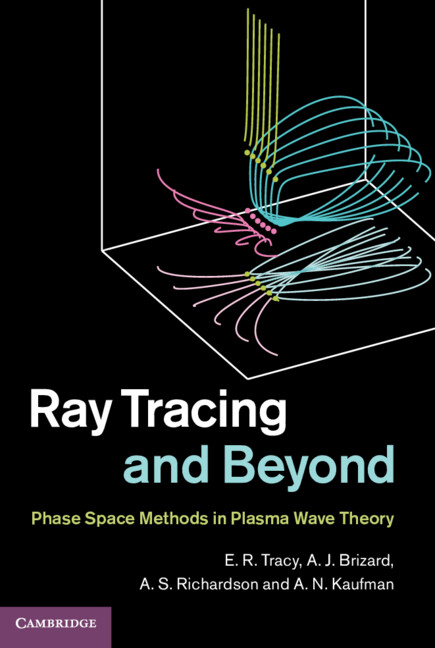
- 作者:
- E. R. Tracy
- A. J. Brizard
- A. S. Richardson
- A. N. Kaufman
- 译者:
- 暂无资料
- 出版社:
- Cambridge University Press
- 出品方:
- 暂无资料
- 出版日期:
- 2014-02-27
- ISBN:
- 978-0-521-76806-1
- 页数:
- 暂无资料
- 装帧:
- 精装(Hardback)
- 定价:
- 暂无资料
- 丛书:
- 暂无资料
内容简介
- 创作背景:
- 序言指出现代短波渐近理论在数学及部分物理领域已有进展,但等离子体物理中的射线追踪教学和实践未充分吸收这些发展;本书旨在弥合这一方法与应用之间的缺口。
- 核心观点:
- 以Weyl符号演算处理矢量波方程
- 用变分原理统一推导射线动力学与守恒律
- 在相空间中处理焦散、隧穿、模式转换及波粒共振
- 由射线族构造满足边界条件的相干波场
- 研究问题:
- 如何将现代射线追踪用于非均匀等离子体中的矢量波?
- 如何在程函近似失效区构造并匹配局部解?
- 主要人物:
- 暂无资料
- 涉及地点:
- 暂无资料
- 涉及事件:
- 暂无资料
- 相关术语:
- 程函近似
- 波作用量
- Weyl符号演算
- 拉格朗日流形
- 模式转换
- 回旋共振
- 争议与批评:
- 暂无资料
- 简介与摘录译文:
- source_language
- en
- target_language
- zh-CN
- source_location
- 前置页 RAY TRACING AND BEYOND 下两段出版社简介;对应 sections.abstract
- edition
- Cambridge University Press,2014年精装版,ISBN 978-0-521-76806-1
- source_uri
- urn:sha256:e6ff39d2ca36e833bf38df92b31605542eb332b1799af41f7bf011b76d346a8b
- method
- AI翻译,依据本版原始简介逐段翻译;非出版社官方译文
- 原文
- This complete introduction to the use of modern ray-tracing techniques in plasma physics describes the powerful mathematical methods generally applicable to vector wave equations in nonuniform media, and clearly demonstrates the application of these methods to simplify and solve important problems in plasma wave theory. Key analytical concepts are carefully introduced as needed, encouraging the development of a visual intuition for the underlying methodology, with more advanced mathematical concepts succinctly explained in the appendices, and supporting MATLAB code available online. Covering variational principles, covariant formulations, caustics, tunneling, mode conversion, weak dissipation, wave emission from coherent sources, incoherent wave fields, and collective wave absorption and emission, all within an accessible framework using standard plasma physics notation, this is an invaluable resource for graduate students and researchers in plasma physics.
- 译文
- 本书全面介绍现代射线追踪技术在等离子体物理中的应用,阐述普遍适用于非均匀介质中矢量波方程的强大数学方法,并清晰展示如何运用这些方法简化和解决等离子体波理论中的重要问题。 书中根据需要循序介绍关键分析概念,帮助读者建立对基本方法的直观认识;附录简明解释更高深的数学概念,并在线提供配套 MATLAB 代码。本书采用标准等离子体物理符号,以易于理解的框架讨论变分原理、协变表述、焦散、隧穿、模式转换、弱耗散、相干源的波发射、非相干波场,以及集体波的吸收与发射,是等离子体物理研究生和研究人员的重要参考资料。
- 原始简介/摘要:
- This complete introduction to the use of modern ray-tracing techniques in plasma physics describes the powerful mathematical methods generally applicable to vector wave equations in nonuniform media, and clearly demonstrates the application of these methods to simplify and solve important problems in plasma wave theory. Key analytical concepts are carefully introduced as needed, encouraging the development of a visual intuition for the underlying methodology, with more advanced mathematical concepts succinctly explained in the appendices, and supporting MATLAB code available online. Covering variational principles, covariant formulations, caustics, tunneling, mode conversion, weak dissipation, wave emission from coherent sources, incoherent wave fields, and collective wave absorption and emission, all within an accessible framework using standard plasma physics notation, this is an invaluable resource for graduate students and researchers in plasma physics.
创作者与相关人物
- 作者简介:
- e. r. tracy is the Chancellor Professor of Physics at the College of William and Mary, Virginia. a. j. brizard is a Professor of Physics at Saint Michael’s College, Vermont. a. s. richardson is a Research Scientist in the Plasma Physics Division of the US Naval Research Laboratory (NRL). a. n. kaufman is an Emeritus Professor of Physics at the University of California, Berkeley.
- 作者:
- E. R. Tracy
- A. J. Brizard
- A. S. Richardson
- A. N. Kaufman
- 编者/主编:
- 暂无资料
- 译者:
- 暂无资料
- 插画师:
- 暂无资料
- 摄影师:
- 暂无资料
- 序言作者:
- 暂无资料
- 后记作者:
- 暂无资料
- 校注者:
- 暂无资料
- 机构作者:
- 暂无资料
- 责任编辑:
- 原书致谢列出的Cambridge编辑团队:Anne Rix、Jessica Murphy、Elizabeth Horne、Simon Capelin;此前参与者:Zoe Pruce、Fiona Saunders、Antoaneta Ouzounova。
- 研究者与评论者:
- 暂无资料
目录
- 章节目录:
- ## Contents Preface page xiii Acknowledgements xix Introduction 1 1.1 Fermat's principle of stationary time 2 1.1.1 General comments 2 1.1.2 Uniform media 3 1.1.3 Snell's Law 4 1.1.4 Distributed sources 5 1.1.5 Stationarity vs. minimization: the law of reflection 6 1.1.6 Smoothly varying media 9 1.2 Hamilton's principle of stationary phase 11 1.2.1 Phase speed 12 1.2.2 Phase integrals and rays 14 1.3 Modern developments 18 1.3.1 Quantum mechanics and symbol calculus 18 1.3.2 Ray phase space and plasma wave theory 22 1.4 One-dimensional uniform plasma: Fourier methods 27 1.4.1 General linear wave equation: $D(-i\partial_x, i\partial_t)\psi = 0$ 28 1.4.2 Dispersion function: $D(k, \omega)$ 29 1.4.3 Modulated wave trains: group velocity and dispersion 31 1.4.4 Weak dissipation 34 1.4.5 Far field of dispersive wave equations 35 1.5 Multidimensional uniform plasma 38 1.6 One-dimensional nonuniform plasma: ray tracing 40 1.6.1 Eikonal equation for an EM wave 40 1.6.2 Wave-action conservation 42 1.6.3 Eikonal phase $\theta(x)$ 43 ## Contents 1.6.4 Amplitude $A(x)$ 44 1.6.5 Hamilton's equations for rays 45 1.6.6 Example: reflection of an EM wave near the plasma edge 46 1.7 Two-dimensional nonuniform plasma: multidimensional ray tracing 47 1.7.1 Eikonal equation for an EM wave 48 1.7.2 Wave-action conservation 48 1.7.3 Eikonal phase $\theta(x,y)$ and Lagrange manifolds 49 1.7.4 Hamilton's equations for rays 49 Problems 51 References 55 2 Some preliminaries 62 2.1 Variational formulations of wave equations 62 2.2 Reduced variational principle for a scalar wave equation 63 2.2.1 Eikonal equation for the phase 64 2.2.2 Noether symmetry and wave-action conservation 64 2.3 Weyl symbol calculus 66 2.3.1 Symbols in one spatial dimension 66 2.3.2 Symbols in multiple dimensions 72 2.3.3 Symbols for multicomponent linear wave equations 74 2.3.4 Symbols for operator products: the Moyal series 74 Problems 76 References 78 3 Eikonal approximation 80 3.1 Eikonal approximation: $x$ -space viewpoint 81 3.2 Eikonal approximation: phase space viewpoint 84 3.2.1 Lifts and projections 89 3.2.2 Matching to boundary conditions 92 3.2.3 Higher-order phase corrections 94 3.2.4 Action transport using the focusing tensor 95 3.2.5 Pulling it all together 97 3.2.6 Frequency-modulated waves 102 3.2.7 Eikonal waves in a time-dependent background plasma 104 3.2.8 Symmetries 105 3.2.9 Curvilinear coordinates 108 3.3 Covariant formulations 111 3.3.1 Lorentz-covariant eikonal theory 111 3.3.2 Energy-momentum conservation laws 119 Contents ix 3.4 Fully covariant ray theory in phase space 121 3.5 Special topics 128 3.5.1 Weak dissipation 129 3.5.2 Waveguides 132 3.5.3 Boundaries 134 3.5.4 Wave emission from a coherent source 139 3.5.5 Incoherent waves and the wave kinetic equation 142 Problems 146 References 151 4 Visualization and wave-field construction 154 4.1 Visualization in higher dimensions 155 4.1.1 Poincaré surface of section 155 4.1.2 Global visualization methods 157 4.2 Construction of wave fields using ray-tracing results 170 4.2.1 Example: electron dynamics in parallel electric and magnetic fields 173 4.2.2 Example: lower hybrid cutoff model 173 References 182 5 Phase space theory of caustics 183 5.1 Conceptual discussion 187 5.1.1 Caustics in one dimension: the fold 187 5.1.2 Caustics in multiple dimensions 191 5.2 Mathematical details 193 5.2.1 Fourier transform of an eikonal wave field 194 5.2.2 Eikonal theory in $k$ -space 196 5.3 One-dimensional case 198 5.3.1 Summary of eikonal results in $x$ and $k$ 198 5.3.2 The caustic region in $x$ : Airy's equation 200 5.3.3 The normal form for a generic fold caustic 205 5.3.4 Caustics in vector wave equations 210 5.4 Caustics in $n$ dimensions 212 Problems 218 References 226 6 Mode conversion and tunneling 228 6.1 Introduction 228 6.2 Tunneling 242 6.3 Mode conversion in one spatial dimension 247 ## Contents 6.3.1 Derivation of the $2 \times 2$ local wave equation 247 6.3.2 Solution of the $2 \times 2$ local wave equation 252 6.4 Examples 258 6.4.1 Budden model as a double conversion 259 6.4.2 Modular conversion in magnetohelioseismology 261 6.4.3 Mode conversion in the Gulf of Guinea 263 6.4.4 Modular approach to iterated mode conversion 269 6.4.5 Higher-order effects in one-dimensional conversion models 273 6.5 Mode conversion in multiple dimensions 276 6.5.1 Derivation of the $2 \times 2$ local wave equation 276 6.5.2 The $2 \times 2$ normal form 279 6.6 Mode conversion in a numerical ray-tracing algorithm: RAYCON 283 6.7 Example: Ray splitting in rf heating of tokamak plasma 295 6.8 Iterated conversion in a cavity 301 6.9 Wave emission as a resonance crossing 303 6.9.1 Coherent sources 304 6.9.2 Incoherent sources 308 Problems 310 Suggested further reading 322 References 323 7 Gyroresonant wave conversion 327 7.1 Introduction 327 7.1.1 General comments 329 7.1.2 Example: Gyroballistic waves in one spatial dimension 331 7.1.3 Minority gyroresonance and mode conversion 333 7.2 Resonance crossing in one spatial dimension: cold-plasma model 335 7.3 Finite-temperature effects in minority gyroresonance 348 7.3.1 Local solutions near resonance crossing for finite temperature 359 7.3.2 Solving for the Bernstein wave 373 7.3.3 Bateman-Kruskal methods 379 Problems 385 References 392 Appendix A Cold-plasma models for the plasma dielectric tensor 394 A.1 Multifluid cold-plasma models 395 A.2 Unmagnetized plasma 397 ## Contents A.3 Magnetized plasma 399 A.3.1 $\mathbf{k} \parallel \mathbf{B}_0$ 400 A.3.2 $\mathbf{k} \nparallel \mathbf{B}_0$ 401 A.4 Dissipation and the Kramers-Kronig relations 403 Problems 404 References 405 Appendix B Review of variational principles 406 B.1 Functional derivatives 406 B.2 Conservation laws of energy, momentum, and action for wave equations 408 B.2.1 Energy-momentum conservation laws 408 B.2.2 Wave-action conservation 409 References 411 Appendix C Potpourri of other useful mathematical ideas 412 C.1 Stationary phase methods 412 C.1.1 The one-dimensional case 412 C.1.2 Stationary phase methods in multidimensions 416 C.2 Some useful facts about operators and bilinear forms 421 Problem 424 References 424 Appendix D Heisenberg-Weyl group and the theory of operator symbols 426 D.1 Introductory comments 426 D.2 Groups, group algebras, and convolutions on groups 427 D.3 Linear representations of groups 430 D.3.1 Lie groups and Lie algebras 434 D.4 Finite representations of Heisenberg-Weyl 436 D.4.1 The translation group on $n$ points 436 D.4.2 The finite Heisenberg-Weyl group 439 D.5 Continuous representations 442 D.6 The regular representation 445 D.7 The primary representation 445 D.8 Reduction to the Schrödinger representation 446 D.8.1 Reduction via a projection operator 446 D.8.2 Reduction via restriction to an invariant subspace 446 D.9 The Weyl symbol calculus 447 References 452 Appendix E Canonical transformations and metaplectic transforms 453 E.1 Examples 453 E.2 Two-dimensional phase spaces 457 E.2.1 General canonical transformations 457 E.2.2 Metaplectic transforms 459 E.3 Multiple dimensions 466 E.3.1 Canonical transformations 466 E.3.2 Lagrange manifolds 467 E.3.3 Metaplectic transforms 469 E.4 Canonical coordinates for the $2 \times 2$ normal form 471 References 476 Appendix F Normal forms 479 F.1 The normal form concept 479 F.2 The normal form for quadratic ray Hamiltonians 482 F.3 The normal form for $2 \times 2$ vector wave equations 488 F.3.1 The Braam-Duistermaat normal forms 497 F.3.2 The general case 497 References 499 Appendix G General solutions for multidimensional conversion 500 G.1 Introductory comments 500 G.2 Summary of the basis functions used 500 G.3 General solutions 504 G.4 Matching to incoming and outgoing fields 506 Reference 510 Glossary of mathematical symbols 511 Author index 514 Subject index 517
- 正文7章:Introduction;Some preliminaries;Eikonal approximation;Visualization and wave-field construction;Phase space theory of caustics;Mode conversion and tunneling;Gyroresonant wave conversion。另有附录A–G、数学符号表、作者索引和主题索引。
原文摘录
- 摘录与页码:
- The major theme of the book concerns the use of phase space methods. Originally developed by Hamilton for the study of optics, these methods became a familiar tool in the study of classical particle motion, and they are part of the standard toolkit for any physicist. The use of phase space methods in the study of plasma waves and the Weyl symbol calculus – and the underlying group theoretical and geometrical ideas these methods are based upon – are more recent developments that are less well-known in the plasma physics community.
- 序言:
- # Preface Waves exist in a great variety of media (in all phases of matter) as well as a vacuum (in the case of electromagnetic waves). All simple waves, on the one hand, share some basic properties such as amplitude, frequency and period, wavelength, and wave velocity (both phase and group velocity). Waves in a turbulent medium, or waves generated by random sources, on the other hand, are more appropriately described in terms of probability distributions of amplitude, and spectral densities in frequency and wavelength. In this book, we focus primarily upon coherent waves that are locallyplane wave in character. That is, they have a well-defined amplitude, phase, and polarization at most (but not all) points. The regions where this local plane-wave approximation breaks down are important, and the development of appropriate local methods to deal with them is an important topic of the book. We include a very short discussion of phase space approaches for incoherent waves, for completeness. This is the first book to present modern ray-tracing theory and its application in plasma physics. The emphasis is on methods and concepts that are generally applicable, including methods for visualizing ray families in higher dimensions. A self-contained exposition is given of the mathematical foundations of ray-tracing theory for vector wave equations, based upon the Weyl theory of operator symbols. Variational principles are used throughout. These provide a means to derive a Lorentz-covariant ray theory, along with related conservation laws for energy, momentum, and wave action. Phase space variational principles are also used to provide a unified treatment of caustics, tunneling, mode conversion, and gyroresonant wave–particle interactions. Many examples are presented to show the power of these ideas to simplify and solve problems in plasma wave theory. Each chapter ends with a set of problems that allows the reader to explore the topics in more depth. The major theme of the book concerns the use of phase space methods. Originally developed by Hamilton for the study of optics, these methods became a familiar tool in the study of classical particle motion, and they are part of the standard toolkit for any physicist. The use of phase space methods in the study of plasma waves and the Weyl symbol calculus – and the underlying group theoretical and geometrical ideas these methods are based upon – are more recent developments that are less well-known in the plasma physics community. The theory of short-wavelength asymptotics has advanced significantly since the 1960s. There is now a large literature on the topic in mathematics and certain subfields of physics, such as atomic, molecular, and optical (AMO) physics, and nuclear physics. This revolution in understanding has produced a relatively minor impact upon ray tracing as practiced by most plasma physicists. There are several reasons for this. First, the modern theory of short-wavelength asymptotics (which is called “semiclassical analysis” in the AMO literature) is couched in mathematical terms that are unfamiliar to scientists who are trained in traditional approaches to plasma wave theory. Traditional approaches tend to emphasize the particular, rather than the general. There is a large emphasis placed upon naming the multitudes of modes, and their classification. These ideas are important, but they can overwhelm the student and the researcher with details and obscure the underlying universal principles. Most students are introduced to plasma wave theory in the uniform setting where Fourier methods apply. They are presented with a survey of the various types of plasma waves. They then quickly skip over how Fourier methods must be modified in a nonuniform plasma. If they are lucky, they are given a superficial introduction to a form of ray-tracing theory that is one-dimensional and largely of nineteenthcentury vintage. As a result, most plasma physicists are completely unaware of the revolution that has occurred in ray-tracing theory, and they are therefore poorly prepared to apply it to their own area of work. Second, if students explore ray tracing in the mathematics literature, they will find that there is a relatively limited range of examples studied, such as the singleparticle Schrodinger equation, or the wave equation with a spatially dependent¨ wave speed. Plasma wave equations have a much richer variety. Plasma wave equations include phenomena that the mathematical literature overlooks, such as wave–particle resonance, gyroresonance, and finite-temperature effects. Dissipation is often ignored in the mathematical literature, as is wave emission, matching to boundary conditions, and Lorentz covariance. All of these topics are important in plasma applications, and all are covered in this book. Third, instead of introducing students to these important theoretical ideas in plasma wave theory, there has been a growing emphasis on teaching full-wave simulation methods. While computational tools for the study of waves are very important (and will continue to grow in importance), the lack of coverage of modern eikonal theory leaves many students and researchers without a firm grasp of its use in wave problems. Ray-tracing codes, which do not include the modern improvements mentioned above, are commonly used for “quick-and-dirty” calculations by experimentalists. This is done for the simple reason that following rays provides insight and promotes physical intuition in practical situations. But by following a collection of rays independently, as is commonly done in such calculations, one is really treating the wave field as incoherent without regard to proper matching to boundary values. This also makes it impossible to correctly compute the wave amplitude. A coherent wave field, properly matched to given boundary values, must be synthesized using a family of rays that have a well-defined set of properties. With some effort (for example by properly dealing with mode conversion), the calculation can be kept “quick” but “cleaned up” so it can be used to accurately compute the phase, amplitude, and polarization along each ray, thereby providing the possibility for a full construction of the wave field. A major focus of the book is the investigation of the processes by which waves, or waves and particles, interact with each other, so that they may exchange energy, momentum, and wave action. These basic processes arise in various settings, and a unified treatment is possible. Examples include mode conversion, wave absorption, and emission by resonant particles in nonuniform plasma. In order for such conversion to take place, certain resonance conditions involving the participating waves, or waves and particles, must be met. These conditions are described in terms of the dynamics of Hamiltonian orbits in ray phase space, and particle orbits in particle phase space. While the focus will be on cold-plasma models for pedagogic purposes, we also include a discussion of finite-temperature effects for completeness (Chapter 7). The effects of finite temperature are studied using Case–van Kampen methods, with the theory adapted to the ray phase space setting. A reader already well-versed in plasma physics should find the examples very familiar, though the method of analysis pursued in later chapters is likely to be new, as well as our emphasis on the use of variational principles. A brief derivation of the cold-plasma fluid model is included in Appendix A for those readers who are not plasma physicists. More detailed discussions of the physical assumptions underlying the models can be found in the references cited. Chapter 1 begins with some introductory comments and examples. A brief historical survey is presented to provide context and to highlight some of the more recent developments in ray tracing. The historical survey here is highly selective, and the narrative provides a first introduction to topics such as the use of variational principles to derive wave equations and their conservation laws, Hamilton’s ray theory, Weyl’s theory of operator symbols, and the much more recent use of these foundational ideas in plasma theory. A brief introduction to eikonal theory for a scalar wave equation is then presented, starting with a quick review of waves in uniform plasma, Fourier methods, and the concepts of phase velocity, group velocity, dispersion, and diffraction. Eikonal methods are then introduced in order to study waves in nonuniform plasma. The treatment here is very traditional, using asymptotic series and brute force calculation. In Chapter 2, we introduce two important tools that will be used throughout the later chapters: variational methods for wave equations and the Weyl symbol calculus. The use of a variational principle allows a unified treatment of later topics, and provides an elegant derivation of the wave-action conservation law using Noether’s theorem. (Further discussion of variational methods and Noether’s theorem is provided in Appendix B.) The Weyl theory ofoperator symbols underlies everything done later in the book.<sup>1</sup> This theory was first developed in the context of quantum mechanics, but the methods are completely general and they provide a systematic means for deriving wave equations that are local in both x and k. These methods are needed for dealing with caustics, tunneling, and mode conversion, all of which involve a breakdown of the eikonal approximation that is local in ray phase space. In Chapter 3, we begin our discussion of eikonal theory for vector wave equations in earnest. In this chapter, we transition by stages from the more familiar x-space discussion of eikonal theory to a covariant phase space treatment. In many settings, the covariant formulation is not needed, and we strive to keep things as concrete as possible. Therefore, in this book we tend to use a preferred laboratory frame and work with physical fields $( e . g . \ \mathbf { E } ( \mathbf { x } , t )$ and $\mathbf { B } ( \mathbf { x } , t ) )$ , rather than allowing arbitrary frames and using four-vector notation and the vector potential $A _ { \mu } ( x )$ . However, covariant formulations are needed in some astrophysical and space plasma applications, so we include them even if they are not a major focus of the book. The conservation of energy, momentum, and wave action is covered in this chapter. Chapter 4 discusses visualization and wave-field construction. The modern theory of ray tracing is a geometrical theory. Geometrical theories appeal to the visual intuition. A visual picture can help guide us through a calculational thicket by providing a map. Mixing metaphors, the goal of this chapter is to help bring visual intuition onto the battlefield as a valued ally along with the more analytical methods of calculation. This chapter also provides examples of the construction of wave fields from ray-based data. This section connects us directly back to the original motivation of eikonal theory: to find solutions of wave equations. The next three chapters concern situations where the eikonal approximation breaks down in various ways.<sup>2</sup> Chapter 5 presents the phase space theory of caustics. These involve a breakdown ofthe eikonal approximation in x-space, but not in k-space. Hence, caustics are dealt with by moving between the x- and k-representations, solving for the local wave behavior near the caustic in the k-representation, then matching to the incoming and outgoing fields in the x-representation. This strategy works because of certain fundamental results from the theory of phase integrals; hence, we provide an extensive discussion ofstationaryphase methods in Appendix C. Chapter 5 involves the first encounter with what are called normal form methods, which also play an important role in the chapters that follow. Chapter 6 treats tunneling and mode conversion. These phenomena are due to a resonance in ray phase space. In the case of mode conversion, two distinct types of eikonal waves, associated with two polarizations, have dispersion functions that are nearly degenerate, meaning that – for a given wave frequency ω – at some point x these two wave types have nearly equal values of k. This causes a breakdown in the eikonal approximation, which is not valid in any representation near the mode conversion point. Weyl methods are used, in tandem with variational principles, to derive the appropriate local wave equation, which is a 2 2 vector wave equation involving the polarizations of the two wave types undergoing conversion.<sup>4</sup> This local wave equation is then solved and matched to incoming and outgoing eikonal fields.<sup>5</sup> Chapter 7 discusses the phase space theory of gyroresonant wave conversion. This phenomenon presents a significant challenge for full-wave simulation because of the wide range of spatial scales involved. The inclusion of finite-temperature effects makes the problem even more challenging numerically. A phase space theory, however, allows us to treat the problem in modular fashion, and to use matched asymptotics to construct a complete solution throughout the resonance region. The calculation is the most technical in the book, but self-contained, and it illustrates the power of phase space ideas. Examples are scattered throughout the book. They are drawn from a wide range of applications in plasma physics and beyond. The phase space theory of Buddentype resonances is covered in great detail at various places in the book, in one dimension and tokamak geometry, for cold and warm plasma. The ray-tracing algorithm RAYCON is described. This is the first ray-tracing algorithm that can deal with ray splitting due to mode conversion in tokamak geometry. In addition, mode conversion in magnetohelioseismology and equatorial ocean waves is briefly covered to illustrate the wide applicability of the methods. Many of the more technical details, and additional mathematical topics, have been relegated to an extended set of appendices. The power of the phase space viewpoint will become apparent as these various topics are developed. The discussions in the main part of the book are kept relatively brief, with an emphasis on the concepts. To avoid bogging down the discussion, many technical details are either presented in the appendices, or developed as exercises for the reader. An extensive list of citations is provided for readers who wish to learn even more. Those who are new to these ideas are strongly encouraged to attempt the problems, as the only way to learn is by doing. The many figures provided in the text are a key part of the discussion; they help to develop geometrical intuition. In particular, the MATLAB code RAYCON – which was used to generate the figures for ray tracing in tokamaks in Section 6.6 – is available online as a supplement to the text, and the reader is encouraged to use this code as well. Our goal is to make the material accessible and useful to a wide audience. We have written the material for graduate students in plasma physics and related fields, which should also make it accessible to researchers in these fields as well. We assume that the reader is mathematically sophisticated, but that the primary interest of the reader lies in understanding how to apply these methods to real physical problems. Comments and suggestions are welcome.
- 后记:
- 暂无资料
出版与版本
- 出版社:
- Cambridge University Press
- 出品方:
- 暂无资料
- 出版地:
- Cambridge, United Kingdom;New York, United States
- 出版日期:
- 2014-02-27
- 版次:
- 第1版(2014年首次出版)
- 印次:
- 暂无资料
- 丛书:
- 暂无资料
- 卷册:
- 暂无资料
- 本版语言:
- 英语
- 装帧:
- 精装(Hardback)
- 页数:
- 暂无资料
- 开本/尺寸:
- 暂无资料
- 重量:
- 暂无资料
- 印数:
- 暂无资料
- 其他版本:
- 标题
- Ray Tracing and Beyond: Phase Space Methods in Plasma Wave Theory(2014电子版)
- relationship
- 同一作品的电子出版版本
- isbn
- 9780511667565
- publisher
- Cambridge University Press
- publication_date
- 2014-04-05
- 说明
- 出版社登记第1版;此关联不表示修订版或译本。
书目标识
- ISBN:
- 978-0-521-76806-1
- 国家图书馆号:
- LCCN 2013028341
- 图书馆分类号:
- LCC QC718.5.W3T72 2014;DDC 530.4′12(dc23)
- 出版社编号:
- 暂无资料
- 外部数据库标识:
- DOI
- 10.1017/CBO9780511667565
- LCCN
- 2013028341
- ISBN_print
- 9780521768061
- ISBN_electronic
- 9780511667565
相关作品与文献
- 相关书籍:
- 暂无资料
- 相关论文:
- 标题
- Ray-based methods in multidimensional linear wave conversion
- authors
- Eugene R. Tracy
- Allan N. Kaufman
- Alain J. Brizard
- journal
- Physics of Plasmas
- 年份
- 2003
- volume
- 10
- pages
- 2147–2154
- DOI
- 10.1063/1.1543579
- 关系类型
- 同作者团队关于多维线性波转换的射线方法论文;依据已关联Crossref原始元数据及摘要确认主题相关
- 学术书评:
- 暂无资料
- 引用与被引用:
- database
- Crossref
- count
- 70
- snapshot_date
- 2026-11-02
- scope
- 整书DOI 10.1017/cbo9780511667565 的 is-referenced-by-count;非全部数据库累计引用量
- 相关项目与会议:
- RAYCON:书中第6.6节介绍的射线追踪算法;原书说明配套MATLAB代码在线提供。
- 同系列作品:
- 暂无资料
- 前作:
- 暂无资料
- 续作:
- 暂无资料
- 影视/舞台/游戏改编:
- 暂无资料
- 推荐阅读与书单:
- 暂无资料
荣誉与影响
- 获奖记录:
- 暂无资料
- 入选榜单:
- 暂无资料
- 销量记录:
- 暂无资料
- 再版情况:
- 暂无资料
- 社会影响:
- 暂无资料
- 学术影响:
- 暂无资料
- 历史地位:
- 暂无资料
短评与书评
- 外部用户评论:
- 暂无资料
更多书籍资料
作品信息
- 副标题:
- Phase Space Methods in Plasma Wave Theory
- 原作名:
- Ray Tracing and Beyond: Phase Space Methods in Plasma Wave Theory
- 别名:
- 暂无资料
- 简要介绍:
- 原文
- 本书以相空间方法介绍现代射线追踪理论及其在等离子体波中的应用,以变分原理和 Weyl 符号演算为基础,讨论程函近似、协变表述、波场可视化与构造、焦散、隧穿、模式转换及回旋共振波转换。书中配有例题与习题,附录补充数学基础,面向等离子体物理研究生和研究人员。
- type
- 站内整理
- basis
- 2014年CUP精装版前置简介、序言及目录
- 原创语言:
- 英语
- 创作时间:
- 暂无资料
- 首次出版时间:
- 2014
- 首次出版国家/地区:
- 英国;美国
- 原始出版社:
- Cambridge University Press
电子书与有声书
- 电子书格式:
- PDF(已登记本地原件,文件头%PDF-1.3;另有Markdown转录,不代表官方发行格式)
- 文件大小:
- 8,657,446 字节(登记PDF原件;SHA-256 8451911931ba44b9326e2b5e88c2d7e09d3b3b960f4af8b74f98d3024efb44d5)
- 数字版权保护:
- 暂无资料
- 有声书时长:
- 暂无资料
- 朗读者:
- 暂无资料
- 音频平台:
- 暂无资料
- 无障碍与字幕:
- 暂无资料
定价与获取
- 定价:
- 暂无资料
- 币种:
- 暂无资料
- 价格记录时间:
- 暂无资料
- 销售状态:
- 暂无资料
- 库存状态:
- 暂无资料
- 购买渠道:
- 暂无资料
- 图书馆馆藏:
- 暂无资料
- 二手市场:
- 暂无资料
- 出版成本:
- 暂无资料
- 印刷成本:
- 暂无资料
- 获奖奖金:
- 暂无资料
- 成本口径/估算说明:
- 暂无资料
图片与多媒体
- 封面与书影:
- 暂无资料
- 作者照片:
- 暂无资料
- 目录图片:
- 暂无资料
- 授权扫描件:
- 暂无资料
- 试读文件:
- 暂无资料
- 音频:
- 暂无资料
- 视频:
- 暂无资料
- 地图:
- 暂无资料
- 时间线:
- 暂无资料
- 3D 展示:
- 暂无资料
版权与许可
- 权利人:
- E. R. Tracy
- A. J. Brizard
- A. S. Richardson
- A. N. Kaufman
- 全文版权:
- © E. R. Tracy, A. J. Brizard, A. S. Richardson and A. N. Kaufman 2014
- 图片版权:
- 暂无资料
- 试读授权:
- 暂无资料
- 音频授权:
- 暂无资料
- 许可证:
- 受版权保护;原书未授予开放许可。Crossref登记的出版使用条款:https://www.cambridge.org/core/terms(非开放许可证声明)。
- 版权期限:
- 暂无资料
- 使用限制:
- 受版权保护。除法定例外及相关集体许可协议外,复制本书任何部分须取得Cambridge University Press书面许可。
程序计算
- 质量分数:
- 暂无资料
- 完备性评分:
- 暂无资料
- 可信度评分:
- 暂无资料
- 聚变相关度评分:
- 暂无资料
评论 (0)