
Physics of plasmas
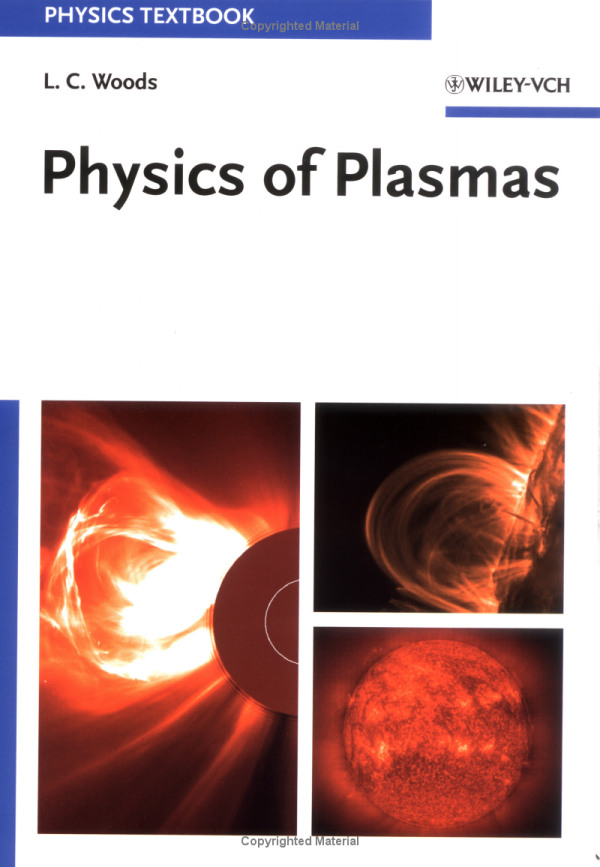
- 作者:
- Leslie C. Woods
- 译者:
- 暂无资料
- 出版社:
- WILEY-VCH Verlag GmbH & Co. KGaA
- 出品方:
- printing
- Strauss Offsetdruck GmbH, Mörlenbach
- bookbinding
- Großbuchbinderei J. Schäffer GmbH & Co. KG, Grünstadt
- 出版日期:
- print_publication_date
- 2003-10-29
- copyright_year
- 2004
- ISBN:
- print_isbn10
- 3-527-40461-9
- print_isbn13
- 9783527404612
- 页数:
- XI-213 p.
- 装帧:
- 平装(broché)
- 定价:
- 暂无资料
- 丛书:
- 暂无资料
内容简介
- 创作背景:
- 作者为需要入门知识的研究生介绍等离子体基本原理,涉及太阳日冕、太阳风、聚变研究及工程应用。
- 核心观点:
- 由碰撞主导的经典流体力学出发,再引入电磁场与无碰撞Vlasov描述。
- 以动力学、波、稳定性和输运为主线,联系聚变与太阳物理等应用。
- 研究问题:
- 磁场如何影响等离子体动力学与约束?
- 磁等离子体中的波、失稳及粒子、能量、动量输运如何描述?
- 主要人物:
- 暂无资料
- 涉及地点:
- 名称
- 太阳日冕
- context
- 自然磁等离子体与太阳物理应用
- 名称
- 太阳风
- context
- 自然磁等离子体实例
- 涉及事件:
- 暂无资料
- 相关术语:
- plasma
- magnetohydrodynamics (MHD)
- Vlasov theory
- Landau damping
- Fokker-Planck equation
- magnetic mirrors
- 争议与批评:
- 作者在序言批评从无碰撞微观模型取矩得到流体方程的通常讲法,认为压力、温度等连续介质概念需要碰撞与局部热平衡;本书采用相反的讲述顺序。
- 简介与摘录译文:
- type
- 原件序言摘录译文
- source_language
- en
- target_language
- zh-CN
- 原文
- The treatment is pitched at a level suitable for graduate students in mathematics, engineering and physics who need an introductory account of plasma physics.
- 译文
- 本书的讲述深度适合需要了解等离子体物理入门知识的数学、工程和物理专业研究生。
- translation_method
- AI翻译,非出版译本
- source_location
- Preface 最后一段首句
- 对应版本
- Wiley-VCH,版权年2004,ISBN 3-527-40461-9
- source_uri
- urn:sha256:a0d76891db497c855bd9a089f8438cc511f9b0dd83b38f49ddddf13f749ff27a
- 原始简介/摘要:
- A short, self-sufficient introduction to the physics of plasma for beginners as well as researchers in a number of fields. The author looks at the dynamics and stability of magnetoplasma and discusses wave and transport phenomena in this medium. The book includes mathematical notes and 99 exercises that supplement the theory presented and thus offers the beginner an easy introduction to this exciting field. It is an equally good textbook for final year undergraduates and first year research students.
创作者与相关人物
- 作者简介:
- 名称
- Leslie C. Woods
- life
- 1922–2007
- affiliation_at_publication
- University of Oxford and Balliol College
- title_at_publication
- Prof. Dr.
- 作者:
- Leslie C. Woods
- 编者/主编:
- 暂无资料
- 译者:
- 暂无资料
- 插画师:
- 暂无资料
- 摄影师:
- scope
- 封面左图
- 图片署名
- NASA
- scope
- 封面右上图
- 图片署名
- M. Aschwanden et al. (LMSAL), TRACE, NASA
- scope
- 封面右下图
- 图片署名
- ESA, NASA
- 序言作者:
- L. C. Woods
- 后记作者:
- 暂无资料
- 校注者:
- 暂无资料
- 机构作者:
- 暂无资料
- 责任编辑:
- 暂无资料
- 研究者与评论者:
- 暂无资料
目录
- 章节目录:
- 1 The Equations of Gas Dynamics 1 1.1 Molecular models and fluids 1 1.1.1 Introduction 1 1.1.2 Microscopic particles 2 1.1.3 The mean free path 3 1.1.4 Fluid particles 4 1.2 Macroscopic variables 4 1.2.1 Number density 4 1.2.2 Fluid velocity 5 1.2.3 Temperature 9 1.2.4 Equations of state 11 1.3 Pressure 12 1.3.1 Macroscopic definition of pressure 13 1.3.2 Kinetic definition of pressure 14 1.3.3 Vanishing pressure gradient 15 1.3.4 Local thermodynamic equilibrium 17 1.4 Macroscopic conservation laws 18 1.4.1 Convection and diffusion 18 1.4.2 A general balance equation in physical space 19 1.4.3 Conservation laws for a simple fluid 21 1.4.4 Specific entropy 22 1.5 Introduction to kinetic theory 23 1.5.1 Kinetic entropy 23 1.5.2 Equilibrium distribution function 24 1.5.3 Averages over velocity space 26 1.5.4 Evolution of the phase-space density 28 1.5.5 Boltzmann's distribution law 29 2 Magnetoplasma Dynamics 33 2.1 Electromagnetic fields 33 2.1.1 Maxwell's equations 33 2.1.2 Galilean transformations 35 2.1.3 Polarization 37 2.2 Basic plasma parameters 39 2.2.1 Plasma neutrality 39 2.2.2 The cyclotron frequency 39 2.2.3 Plasma frequency 40 2.2.4 The Debye length 41 2.3 Magnetohydrodynamic equations 42 2.3.1 Ohm's law 42 2.3.2 Conservation laws in MHD 44 2.3.3 Lagrangian form and entropy production 46 2.4 Electromagnetic forces 48 2.4.1 Stress tensor and Poynting vector 48 2.4.2 Magnetic forces in MHD 49 2.4.3 The induction equation 50 2.4.4 Diffusion of magnetic fields 53 2.4.5 Conservation of magnetic flux 54 2.5 Magnetostatics 54 2.5.1 Steady state equations 54 2.5.2 The theta pinch 55 2.5.3 The linear pinch 56 2.5.4 Axisymmetric toroidal equilibrium 57 2.5.5 Force-free magnetic fields 59 2.6 Transition equations across surface layers 61 2.6.1 Surface intensities 61 2.6.2 Boundary conditions 62 2.6.3 Current sheets and surface charge 64 2.6.4 Fluid equations 64 Waves in Magnetoplasmas 69 3.1 MHD waves in an unbounded plasma 69 3.1.1 Introduction 69 3.1.2 Linearization 70 3.1.3 The dispersion equation 71 3.1.4 MHD waves 73 3.2 Coupled plasma waves 74 3.2.1 High frequency waves 74 3.2.2 Whistlers 75 3.2.3 Propagation of wave fronts 76 3.3 MHD waves in cylindrical plasmas 77 3.3.1 The dispersion relation 77 3.3.2 Fast wave cut-off 79 3.4 Group velocity 80 3.4.1 Transmission of energy 80 3.4.2 Wave packets 81 3.5 Shock waves 82 3.5.1 Jump conditions across an MHD shock 82 3.5.2 Thermodynamic constraint 85 3.5.3 Classification of MHD shocks 87 3.5.4 Perpendicular shock waves 89 3.6 Magneto-ionic theory 92 3.6.1 Electrical conductivity 92 3.6.2 The dielectric tensor 93 4 Magnetoplasma Stability 97 4.1 Rayleigh-Taylor and Kelvin-Helmholtz instabilities 98 4.1.1 Linearized equations 98 4.1.2 Surface waves 99 4.1.3 The dispersion equation 100 4.1.4 Special cases 101 4.2 Interchange instabilities 103 4.2.1 Flute instability 103 4.2.2 Thermal stability 105 4.3 Instabilities of a cylindrical plasma 106 4.3.1 The sausage instability 106 4.3.2 The kink instability 107 4.3.3 Stability condition 108 4.3.4 Stability of an unbounded flux tube 109 4.4 The energy principle 110 4.4.1 Potential energy 111 4.4.2 Surface term 112 4.4.3 General stability condition 113 4.4.4 Cylindrical plasma with a volume current 115 4.5 Resistive instabilities 115 4.5.1 The tearing mode 116 4.5.2 Differential equation for $\hat{B}_y$ 117 4.5.3 Physics of the tearing mode 118 4.6 The two-stream instability 120 4.6.1 Vlasov theory of plasma waves 120 4.6.2 Solution of the dispersion equation 122 4.6.3 Landau damping 123 4.6.4 The ion-acoustic instability 124 4.7 Fibrillation of magnetic fields 126 5 Transport in Magnetoplasmas 131 5.1 Coulomb collisions 131 5.1.1 Particle diffusion in electric microfields 131 5.1.2 Particle orbits 133 5.1.3 The Rutherford scattering cross-section 135 5.2 The Fokker-Planck equation 136 5.2.1 Friction and diffusion coefficients 136 5.2.2 Scattering in velocity space 138 5.2.3 Super-potential functions 139 5.3 Lorentzian plasma 141 5.3.1 Collisional loss rate 141 5.3.2 Expansion of the distribution function 142 5.3.3 Electrical conductivity 143 5.3.4 Conductivity in a fully-ionized plasma 144 5.4 Friction and diffusion coefficients 146 5.4.1 First super-potential 146 5.4.2 Second super-potential 147 5.4.3 Limiting cases 148 5.4.4 Relaxation times 149 5.5 Transport of charge and energy 152 5.5.1 Ohm's law 152 5.5.2 Resistivity in a magnetoplasma 152 5.5.3 Fourier's Law 153 5.5.4 Thermal conductivity in a magnetoplasma 154 5.6 Transport of momentum 155 5.6.1 Classical formula for the viscous stress tensor 155 5.6.2 The viscous stress tensor in a magnetic field 157 Extensions of Theory 165 6.1 Second-order transport 165 6.1.1 Convection versus conduction 166 6.1.2 The second-order heat flux 167 6.1.3 The viscous stress tensor 170 6.2 Thermal instability 170 6.2.1 Heat flux in a cylindrical magnetoplasma 170 6.2.2 Unstable current profiles 172 6.2.3 Planar geometry 174 6.2.4 Heating the solar corona 175 6.3 Particle orbit theory 176 6.3.1 Rate of change of the peculiar velocity 176 6.3.2 Guiding centre drifts 177 6.3.3 Drifts due to variations in the magnetic field 179 6.3.4 Gyro-averages 180 6.3.5 The grad B and field curvature drifts 182 6.4 Magnetic mirrors 184 6.4.1 Constants of motion of gyrating particles 184 6.4.2 Magnetically trapped particles 185 6.4.3 Fraction of trapped particles 186 6.5 Partially ionized plasmas 187 6.5.1 Degree of ionization 187 6.5.2 Ratio of the specific heats 188 6.5.3 Resistivity 190 6.6 Applications of plasma physics 191 6.6.1 Tokamak research 192 6.6.2 Solar physics 194 6.6.3 Engineering applications 196 6.6.4 Dusty plasmas 197 Bibliography 207 Index 209
原文摘录
- 摘录与页码:
- This text gives an account of the principal properties of a tenuous gas, hot enough for some of the molecules to shed electrons and become ionized. In general a macroscopic volume of such a gas consists of a mixture of free electrons and the ions and neutrals of several molecular species and is called a plasma. If the temperature is high enough, e.g. $\sim$ 10 000 K at a pressure of 1 Pascal, a hydrogen plasma will be fully ionized, which is the case of most interest in this book. If there is also a magnetic field present, the ions and electrons will gyrate about the field lines, producing an anisotropic medium with some very interesting properties. Because of the orbiting motions, it is more difficult for the plasma to flow across the magnetic field lines than along them and with very strong fields both the plasma and its energy are said to be ‘confined’ by the field, although some leakage across the field lines does occur.
- 序言:
- This text gives an account of the principal properties of a tenuous gas, hot enough for some of the molecules to shed electrons and become ionized. In general a macroscopic volume of such a gas consists of a mixture of free electrons and the ions and neutrals of several molecular species and is called a plasma. If the temperature is high enough, e.g. $\sim$ 10 000 K at a pressure of 1 Pascal, a hydrogen plasma will be fully ionized, which is the case of most interest in this book. If there is also a magnetic field present, the ions and electrons will gyrate about the field lines, producing an anisotropic medium with some very interesting properties. Because of the orbiting motions, it is more difficult for the plasma to flow across the magnetic field lines than along them and with very strong fields both the plasma and its energy are said to be ‘confined’ by the field, although some leakage across the field lines does occur. Examples of naturally occurring magnetoplasmas are found in the Sun's corona, the solar wind and comet's tails; laboratory examples include the plasma created in the fusion research machines known as tokamaks and in the application of what is termed 'plasma processing' to the manufacture of semiconductor devices. Although molten metal is not a plasma, it is a conductor of electricity and therefore subject to magnetic forces; its behaviour is described by the equations of magnetohydrodynamics (MHD), which are a limiting case of the magnetoplasma equations. Electric currents are used in industry to heat metals to the liquid state, when these metals can be stirred, levitated and pumped with magnetic fields. New applications of plasma physics arise from time to time; however, in a short book such as this there is space for little more than the basic principles of the subject. One of the attractions of plasma physics is the range of subjects required for its understanding; these include fluid mechanics, electricity and magnetism, kinetic theory and thermodynamics, although for this text relatively little experience in these topics is assumed. There are many equations, so some effort has been made to cross-reference them at each stage of developing the theory. To help the reader with mathematical points, I have included ‘mathematical notes’ at appropriate stages in the chapters, and I have also have added some appendices covering standard analyses. With a subject like plasma theory, subscripts are essential to distinguish between the properties of the several fluid components, so to avoid doubling up on subscripts, I have followed the common practice of employing the dyadic notation for tensors and where the vector and tensor analysis is complicated, I have filled in the steps involved. Many texts on plasma theory begin with a description of the collisionless motion of individual charged particles known as particle orbit theory. Particles at a given time $t$ and at a point $\mathbf{r}$ in physical space are then grouped according to their velocity $\mathbf{w}$ and a 'kinetic' equation describing the evolution of the number density of particles at a point $\mathrm{P} = \mathrm{P}(\mathbf{r},\mathbf{w},\mathbf{t})$ in phase-space is found. It is at this stage that particle collisions enter the model via a collision operator $\mathbb{C}$ , which removes particles from $\mathbf{P}$ or introduces particles into $\mathbf{P}$ by collisional scattering. Finally, integrals of the kinetic equation over velocity space yield the fluid or MHD equations. However, these moments representing the conservation of mass, momentum and energy, are independent of C, the term containing which vanishes in each integration. Hence C could in fact be zero. The standard account thus precedes from a microscopic description to what purports to be a collisional macroscopic model, without collisions playing any role at all. Terms corresponding to pressure and temperature appear in the moment equations and yet these properties are essentially continuum concepts that require the existence of local thermodynamic equilibrium, a state for which particle collisions are essential. To avoid the confusion and occasional errors that the standard approach has introduced into plasma theory, in this text the subject is developed in the reverse order from that described above, that is we start with collision-dominated classical fluid mechanics in Chapter 1, adding the effects of electromagnetic fields in Chapter 2. At this stage we only need sufficient knowledge of particle orbit theory to determine the length and time scales below which a fluid or continuum description is not valid. Chapter 3 presents the theory of small amplitude plasma waves and shock waves, and finishes with a brief introduction to magneto-ionic theory, required in studying the reflection and scattering of radio waves in the ionosphere. Stability of plasmas is treated in Chapter 4, covering the usual macroscopic instabilities of ideal plasmas, and also an important instability that depends on the electrical resistivity. Finally we remove collisions entirely from the model and introduce the Vlasov theory of plasma waves, applying it to Landau damping and the ion-acoustic instability, which has important applications in solar physics. Chapter 5, which is concerned with transport in magnetoplasmas, starts from the Fokker-Planck equation and gives an account of the theory of electron-ion collision intervals and several other relaxation times of important in the transport of particle energy and momentum. The final chapter collects a miscellany of important topics, including second-order transport theory, thermal instabilities, particle orbit theory, magnetic mirrors, partially ionized plasmas and a brief introduction to some important applications of plasma physics. By second-order transport is meant, for example, the transport of heat in the presence of strong fluid shear, when the heat flux vector depends not only on the temperature gradient as in Fourier's law, but also on the rate of strain of the fluid. This proves to be very important in the presence of magnetic fields and leads to the thermal instabilities next described in the chapter. Particle orbits in the presence of magnetic field gradients is a particularly important phenomenon in near-collisionless plasmas, with applications to transport in tokamaks. Partially ionized plasmas add the complexity of a third fluid comprised of the neutral particles, to the model, so a brief introduction to Saha's equation for the dependence of the degree of ionization on the temperature and pressure is included. The final section briefly describes a few important applications of the theory – fusion research, solar physics, metallurgy, MHD direct generation of electricity and dusty plasmas. The treatment is pitched at a level suitable for graduate students in mathematics, engineering and physics who need an introductory account of plasma physics. It is recommend that the reader should aim to get a clear physical picture of the mechanisms at each stage before checking through the analysis. Most of the exercises are straightforward extensions of the theory and therefore worthy of attention. L. C. Woods Oxford, 1st August, 2003
- 后记:
- 暂无资料
出版与版本
- 出版社:
- WILEY-VCH Verlag GmbH & Co. KGaA
- 出品方:
- printing
- Strauss Offsetdruck GmbH, Mörlenbach
- bookbinding
- Großbuchbinderei J. Schäffer GmbH & Co. KG, Grünstadt
- 出版地:
- Weinheim
- 出版日期:
- print_publication_date
- 2003-10-29
- copyright_year
- 2004
- 版次:
- 第1版
- 印次:
- 暂无资料
- 丛书:
- 暂无资料
- 卷册:
- 暂无资料
- 本版语言:
- en
- 装帧:
- 平装(broché)
- 页数:
- XI-213 p.
- 开本/尺寸:
- 24 cm
- 重量:
- 暂无资料
- 印数:
- 暂无资料
- 其他版本:
- 标题
- Physics of Plasmas(电子版,2007年上线)
- 关系类型
- 同书电子载体版本
- format
- 电子版
- isbn
- 9783527618064
- DOI
- 10.1002/9783527618064
- published_online
- 2007-12-24
书目标识
- ISBN:
- print_isbn10
- 3-527-40461-9
- print_isbn13
- 9783527404612
- 国家图书馆号:
- FRBNF39125038000000X
- 图书馆分类号:
- DDC 23: 530.44
- 出版社编号:
- 暂无资料
- 外部数据库标识:
- type
- OCLC
- 数值
- (OCoLC)ocm54087621
相关作品与文献
- 相关书籍:
- 暂无资料
- 相关论文:
- 暂无资料
- 学术书评:
- 暂无资料
- 引用与被引用:
- database
- Crossref
- DOI
- 10.1002/9783527618064
- cited_by_count
- 3
- indexed_date
- 2026-09-30
- snapshot_accessed
- 2026-11-02
- 说明
- 仅此库计数,非实时或全网总引用量
- 相关项目与会议:
- 名称
- tokamak research
- 关系类型
- 第6.6.1节应用主题,非作者参与具体项目的证明
- 名称
- solar physics
- 关系类型
- 第6.6.2节应用主题
- 同系列作品:
- 暂无资料
- 前作:
- 暂无资料
- 续作:
- 暂无资料
- 影视/舞台/游戏改编:
- 暂无资料
- 推荐阅读与书单:
- 暂无资料
荣誉与影响
- 获奖记录:
- 暂无资料
- 入选榜单:
- 暂无资料
- 销量记录:
- 暂无资料
- 再版情况:
- 暂无资料
- 社会影响:
- 暂无资料
- 学术影响:
- indicator
- Crossref is-referenced-by-count
- 数值
- 3
- indexed
- 2026-09-30
- DOI
- 10.1002/9783527618064
- 说明
- 单库书目计数,仅表明该库记录的引用情况
- 历史地位:
- 暂无资料
短评与书评
- 外部用户评论:
- 暂无资料
更多书籍资料
作品信息
- 副标题:
- 暂无资料
- 原作名:
- Physics of Plasmas
- 别名:
- 暂无资料
- 简要介绍:
- 原文
- 本书从碰撞占主导的经典流体力学出发,介绍磁等离子体动力学、波、稳定性、输运及相关应用,面向需要等离子体物理入门知识的数学、工程与物理研究生。
- type
- 站内整理
- basis
- Wiley-VCH 2004版原件 Preface
- 原创语言:
- 英语
- 创作时间:
- preface_date
- 2003-08-01
- 说明
- 序言落款,创作起止不详
- 首次出版时间:
- 2003-10-29
- 首次出版国家/地区:
- 德国
- 原始出版社:
- Wiley-VCH
电子书与有声书
- 电子书格式:
- format
- basis
- 已关联PDF原件;Crossref也提供application/pdf链接
- format
- Markdown
- basis
- 已关联的本地转录文本,非出版社正式电子书格式
- 文件大小:
- path
- /home/linden/docs/velo/fusionbooks/plasma_library/ebooks/Woods2004_Physics_of_Plasmas.md
- sha256
- a0d76891db497c855bd9a089f8438cc511f9b0dd83b38f49ddddf13f749ff27a
- bytes
- 593707
- 说明
- 工作台登记原件大小,非压缩blob或下载站文件大小
- path
- /home/linden/docs/velo/fusionbooks/plasma_library/ebooks/Woods2004_Physics_of_Plasmas.pdf
- sha256
- 420e26ffde2be3e1307fd0658c4f5b5b9473bb88df87e46977c39000c75687ed
- bytes
- 10019679
- 说明
- 工作台登记原件大小,非压缩blob或下载站文件大小
- 数字版权保护:
- 暂无资料
- 有声书时长:
- 暂无资料
- 朗读者:
- 暂无资料
- 音频平台:
- 暂无资料
- 无障碍与字幕:
- 暂无资料
定价与获取
- 定价:
- 暂无资料
- 币种:
- 暂无资料
- 价格记录时间:
- 暂无资料
- 销售状态:
- 暂无资料
- 库存状态:
- 暂无资料
- 购买渠道:
- type
- 出版者电子书入口
- 说明
- Crossref登记链接,未核实当前购买功能或价格
- 图书馆馆藏:
- library
- Bibliothèque nationale de France
- id
- FRBNF39125038000000X
- location
- Tolbiac - Rez de Jardin - Sciences et technique - Salle S - Libre accès
- call_number
- 530.44 WOOD p
- snapshot_date
- 2026-11-03
- library
- Princeton University
- id
- 9940905173506421
- locations
- Lewis Library
- Princeton Plasma Physics Laboratory
- call_number
- QC718 .W662 2004
- snapshot_date
- 2026-11-03
- 说明
- 快照中的available非当前可借状态
- 二手市场:
- 暂无资料
- 出版成本:
- 暂无资料
- 印刷成本:
- 暂无资料
- 获奖奖金:
- 暂无资料
- 成本口径/估算说明:
- 暂无资料
图片与多媒体
- 封面与书影:
- 来源链接
- internal:original-book-cover:420e26ffde2be3e1307fd0658c4f5b5b9473bb88df87e46977c39000c75687ed:page:1
- alt
- Physics of Plasmas 原件封面
- documentPath
- /home/linden/docs/velo/fusionbooks/plasma_library/ebooks/Woods2004_Physics_of_Plasmas.pdf
- page
- 1
- 作者照片:
- 暂无资料
- 目录图片:
- path
- images/1e5e3eeba9c6ddb13ec1e86f6856b61d19359d72f76f088139d3b390ae1bfbf0.jpg
- scope
- 原件转录首图(封面)
- 说明
- 相对原件路径,未验证独立图片文件是否可访问
- 授权扫描件:
- documentPath
- /home/linden/docs/velo/fusionbooks/plasma_library/ebooks/Woods2004_Physics_of_Plasmas.pdf
- sha256
- 420e26ffde2be3e1307fd0658c4f5b5b9473bb88df87e46977c39000c75687ed
- 说明
- 已关联PDF原件,是否影印扫描版未核实;非公开下载链接
- 试读文件:
- 暂无资料
- 音频:
- 暂无资料
- 视频:
- 暂无资料
- 地图:
- 暂无资料
- 时间线:
- 时间
- 2003-08-01
- event
- 作者在Oxford署序言
- 时间
- 2003-10-29
- event
- Crossref登记首版纸本出版日期;原件版权年为2004
- 时间
- 2004
- event
- 登记原件版权年及BnF cop.2004
- 时间
- 2007-12-24
- event
- Crossref登记电子版上线日期
- 3D 展示:
- 暂无资料
版权与许可
- 权利人:
- copyright_notice
- © 2004 WILEY-VCH Verlag GmbH & Co. KGaA, Weinheim
- scope
- 本版版权页声明;未核实后续权利转移
- 全文版权:
- All rights reserved (including those of translation into other languages). No part of this book may be reproduced in any form – nor transmitted or translated into machine language without written permission from the publishers. Registered names, trademarks, etc. used in this book, even when not specifically marked as such, are not to be considered unprotected by law.
- 图片版权:
- cover_credits
- position
- Left
- 图片署名
- NASA
- position
- Upper right
- 图片署名
- M. Aschwanden et al. (LMSAL), TRACE, NASA
- position
- Lower right
- 图片署名
- ESA, NASA
- 说明
- 仅图像署名;未见单独授权条款,不能据署名推定公有领域或开放许可。
- 试读授权:
- 暂无资料
- 音频授权:
- 暂无资料
- 许可证:
- general
- All rights reserved
- tdm
- scope
- Crossref登记content-version=tdm的文本与数据挖掘条款;未打开许可全文,非开放全文许可
- 版权期限:
- 暂无资料
- 使用限制:
- All rights reserved (including those of translation into other languages). No part of this book may be reproduced in any form – nor transmitted or translated into machine language without written permission from the publishers. Registered names, trademarks, etc. used in this book, even when not specifically marked as such, are not to be considered unprotected by law.
程序计算
- 质量分数:
- 暂无资料
- 完备性评分:
- 暂无资料
- 可信度评分:
- 暂无资料
- 聚变相关度评分:
- 暂无资料
评论 (0)